
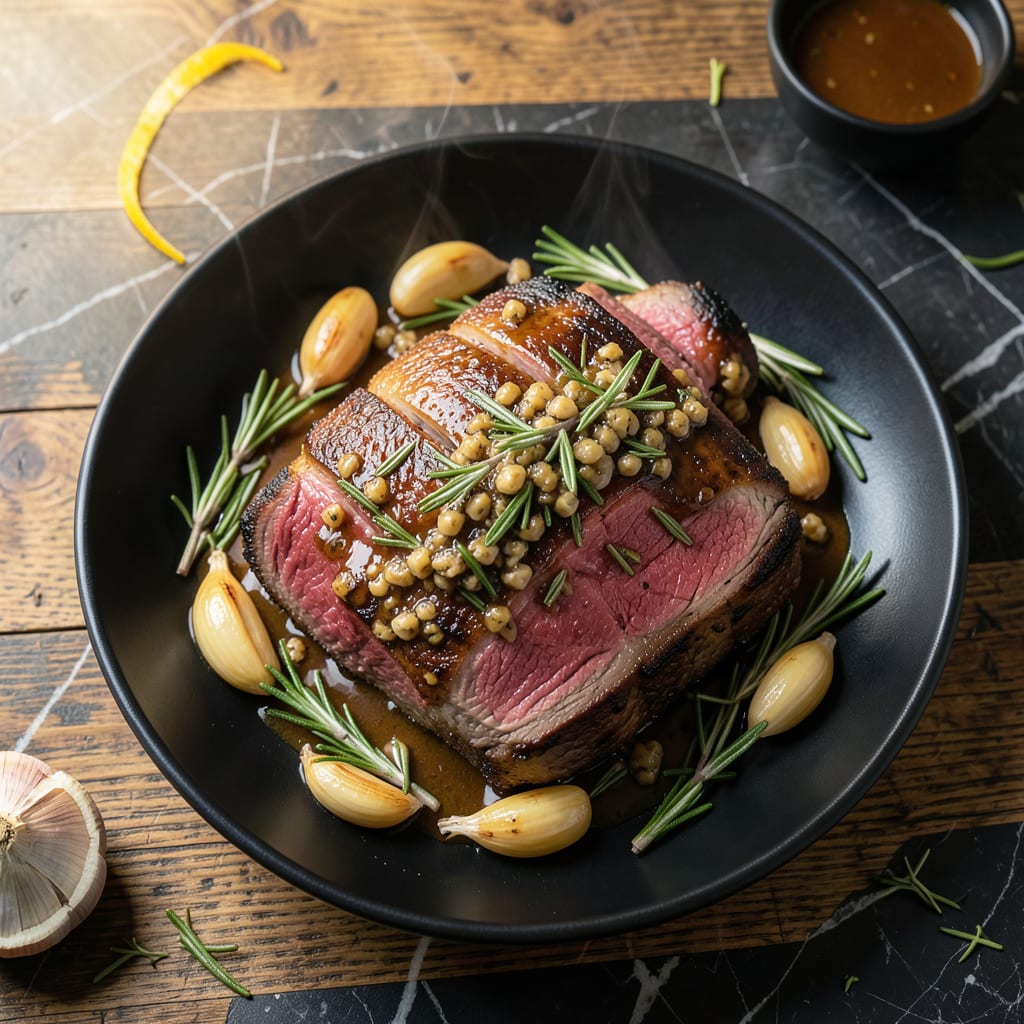
This herb-crusted prime rib delivers restaurant-quality results for your holiday table. The slow-roasting method ensures perfectly pink meat from edge to edge with a flavorful crust.
I’ve refined this technique over years to create a showstopping centerpiece that’s simpler than it looks. The secret is patience and precise temperature control.
Ingredients for Chef John’s Prime Rib
Restaurant-quality prime rib starts with these premium ingredients for your holiday centerpiece.
| Ingredient | Amount | Notes |
|---|---|---|
| Prime Rib Roast 🥩 | 4 lb | Bone-in, well-marbled |
| Kosher Salt 🧂 | 2 tbsp | Diamond Crystal preferred |
| Freshly Ground Black Pepper 🌶️ | 2 tbsp | Coarsely ground |
| Garlic Cloves 🧄 | 6 cloves | Minced into paste |
| Fresh Rosemary 🌿 | 3 tbsp | Finely chopped |
| Fresh Thyme Leaves 🍃 | 2 tbsp | Stems removed |
| Dijon Mustard 🟡 | 2 tbsp | Whole grain acceptable |
| Extra-Virgin Olive Oil 🫒 | ¼ cup | High-quality, fruity |
| Red Wine 🍷 | 1 cup | Dry variety preferred |
| Beef Stock 🥩 | 1 cup | Low-sodium preferred |
| Unsalted Butter 🧈 | 4 tbsp | Softened to room temperature |
| All-Purpose Flour 🌾 | 2 tbsp | For thickening pan juices |
| Horse Radish 🌿 | 3 tbsp | Prepared, for serving |
The prime rib is non-negotiable—bone-in with abundant marbling ensures both flavor and moisture. Costco and Whole Foods reliably carry high-quality cuts. For the herbs, fresh is mandatory; dried simply won’t deliver the vibrant, aromatic crust this dish demands. Look for rosemary and thyme with vibrant color and no wilting. The beef stock should be low-sodium to allow precise seasoning control.
Substitutions are limited but possible. No fresh herbs? Use half the amount of dried, though the texture will differ. Out of red wine? Beef broth with a splash of balsamic vinegar mimics the acidity. For the mustard, whole grain Dijon adds pleasant texture. The butter can be swapped for duck fat if you’re feeling decadent. Skip the horseradish if you prefer, but it cuts through the richness beautifully.
Prime rib is best cooked fresh—don’t buy it more than 2-3 days ahead. Store it unwrapped on a rack in the fridge to dry the surface (better crust). Leftovers keep 4-5 days and make incredible sandwiches. The herb paste can be prepped 1 day in advance; keep it refrigerated in an airtight container.
Why You’ll Love This Recipe
- I’ll be real: the sandwiches I make with the leftovers might be even better than the original meal.
- Set and Forget: I rub the roast with salt, pepper, garlic, and rosemary, pop it in the oven, and let it do its thing—no babysitting required.
- Crust Worth Craving: That garlic-rosemary crust forms the most incredible flavorful seal, and the meat stays juicy underneath.
- Holiday Hero: This is my go-to for Christmas dinner, but honestly, it’s impressive enough for any Sunday supper with family.
Step-by-Step Instructions for Herb-Crusted Prime Rib
Achieve restaurant-quality results with this proven method for a show-stopping holiday centerpiece.
Step 1: Prepare the Herb Crust and Season the Roast
In a small bowl, combine the 2 tbsp Kosher Salt, 2 tbsp Freshly Ground Black Pepper, minced 6 cloves Garlic Cloves, 3 tbsp Fresh Rosemary, and 2 tbsp Fresh Thyme Leaves with the 0.25 cup Extra-Virgin Olive Oil and 2 tbsp Dijon Mustard. This creates a thick, aromatic paste that will form the flavorful crust.
Pat the 4 lb Prime Rib Roast completely dry with paper towels—this ensures the crust adheres properly. Rub the herb mixture evenly over the entire surface of the roast, pressing gently so it clings to the meat. Place the roast on a rack set in a roasting pan, fat-side up, and let it sit at room temperature for 1 hour before cooking.
Step 2: Sear the Roast for Maximum Flavor
Preheat your oven to 450°F. This high initial temperature creates a beautiful, caramelized crust. Place the roast in the oven and cook for 20 minutes to develop a deep, golden-brown exterior. The herb mixture will transform into a fragrant, crisp layer that locks in juices.
After the initial sear, reduce the oven temperature to 325°F. This two-stage cooking process ensures a perfect crust while allowing the interior to cook evenly without drying out. Do not cover the roast—exposing it to the dry heat is crucial for maintaining that crispy exterior.
Step 3: Roast to Perfect Doneness
Continue roasting at 325°F until the internal temperature reaches 120-125°F for medium-rare, which typically takes 1 to 1.5 hours for a 4 lb Prime Rib Roast. Use an instant-read thermometer to check the temperature in the thickest part of the meat, avoiding the bone.
The roast is done when the thermometer reads your desired doneness. Remember, the temperature will rise an additional 5-10°F during resting due to carryover cooking. For medium-rare, look for a deep pink center; for medium, aim for 130-135°F internal temperature before resting.
Step 4: Rest and Prepare the Pan Sauce
Transfer the roast to a cutting board and tent loosely with foil. Let it rest for 20-30 minutes—this allows the juices to redistribute, ensuring every slice is moist and flavorful. While the meat rests, place the roasting pan on the stovetop over medium heat.
Add the 1 cup Red Wine to the pan, scraping up all the browned bits with a wooden spoon. Simmer for 2-3 minutes until reduced by half. Stir in the 1 cup Beef Stock and bring to a simmer. Whisk in the 2 tbsp All-Purpose Flour and 4 tbsp Unsalted Butter to create a rich, velvety sauce. Strain and serve alongside the sliced roast with 3 tbsp Horse Radish.
Pro Tips For Making Chef John’S Prime Rib
- Start High, Finish Low: I learned this the hard way—sear the prime rib at 500°F for 15 minutes first, then drop to 325°F for even cooking. This locks in the crust while keeping the inside perfectly pink.
- Salt the Night Before: Sounds weird, but it works: dry-brine your roast with kosher salt 12-24 hours ahead. It seasons deep and draws out moisture for a better sear.
- Skip the Cold Roast: After burning the ends of a cold prime rib, I finally figured out to let it sit at room temp for 2 hours before cooking. Guarantees even doneness.
- Crush the Garlic: I was skeptical until I tried it—smash the garlic cloves instead of mincing for the rub. It melts into the meat and infuses way more flavor.
Essential Equipment for chef johns prime rib
Roasting Pan Essentials
Invest in a heavy-duty stainless steel roasting pan with a rack—I use All-Clad for even heat distribution. The rack elevates the roast, allowing hot air to circulate underneath for consistent browning. A 12-14 inch pan fits a 4 lb prime rib perfectly. 💡
Precision Temperature Tools
An instant-read thermometer is non-negotiable for prime rib success. I trust my ThermoWorks MK4 for 1°F accuracy. Check internal temp in multiple spots, avoiding bones. Also, an oven thermometer ensures your oven’s 325°F is precise.
Carving Knife Investment
A sharp 8-10 inch slicing knife is key for clean cuts. My Wüsthof Ikon glides through the crust effortlessly. Pair it with a wooden cutting board to protect the blade’s edge. Never use a serrated knife—it tears the meat.
Pan Sauce Must-Haves
For the sauce, a wooden spoon scrapes up fond without scratching your pan. A fine-mesh strainer removes herb bits for silky sauce. I also keep kitchen twine handy to tie herbs if I’m feeling fancy.
Resting Setup
Use aluminum foil to tent the roast while resting. A meat thermometer with probe alerts helps track carryover cooking. Resting on a carving board catches juices for the sauce. This setup guarantees juicy slices every time.
Safety Gear
Handle hot pans with silicone oven mitts—I prefer OXO’s heat-resistant ones. Keep a fire extinguisher nearby when searing at 450°F. These precautions make the process stress-free and safe for home cooks. 🔥
Nutrition Facts
Frequently Asked Questions
Why start with such a high oven temperature?
The initial 450°F sear creates a deep, flavorful crust while locking in juices. This step is crucial for that signature caramelized exterior prime rib is known for.
How do I know when it’s perfectly cooked?
Use an instant-read thermometer—120-125°F for medium-rare. Remember the temperature rises 5-10°F during resting, so pull it early for perfect doneness.
Can I use a boneless roast instead?
Yes, but bone-in adds flavor and helps the meat cook more evenly. If using boneless, reduce cooking time by about 15-20% since it cooks faster.
What if my pan sauce is too thin?
Simmer it longer to reduce, or mix 1 tsp cornstarch with 1 tbsp cold water and whisk in. This thickens it without changing the rich flavor.

- BBQ Sausage Recipe Oven: Smoky Depth Without the Grill - September 28, 2026
- BBQ Chicken Bowl Recipe Rice: Smoky Sweetness Over Fluffy Grains - September 28, 2026
- Beef Cutlet Recipe Ideas: Crispy Breaded Patties With Bold Seasonings - September 28, 2026