
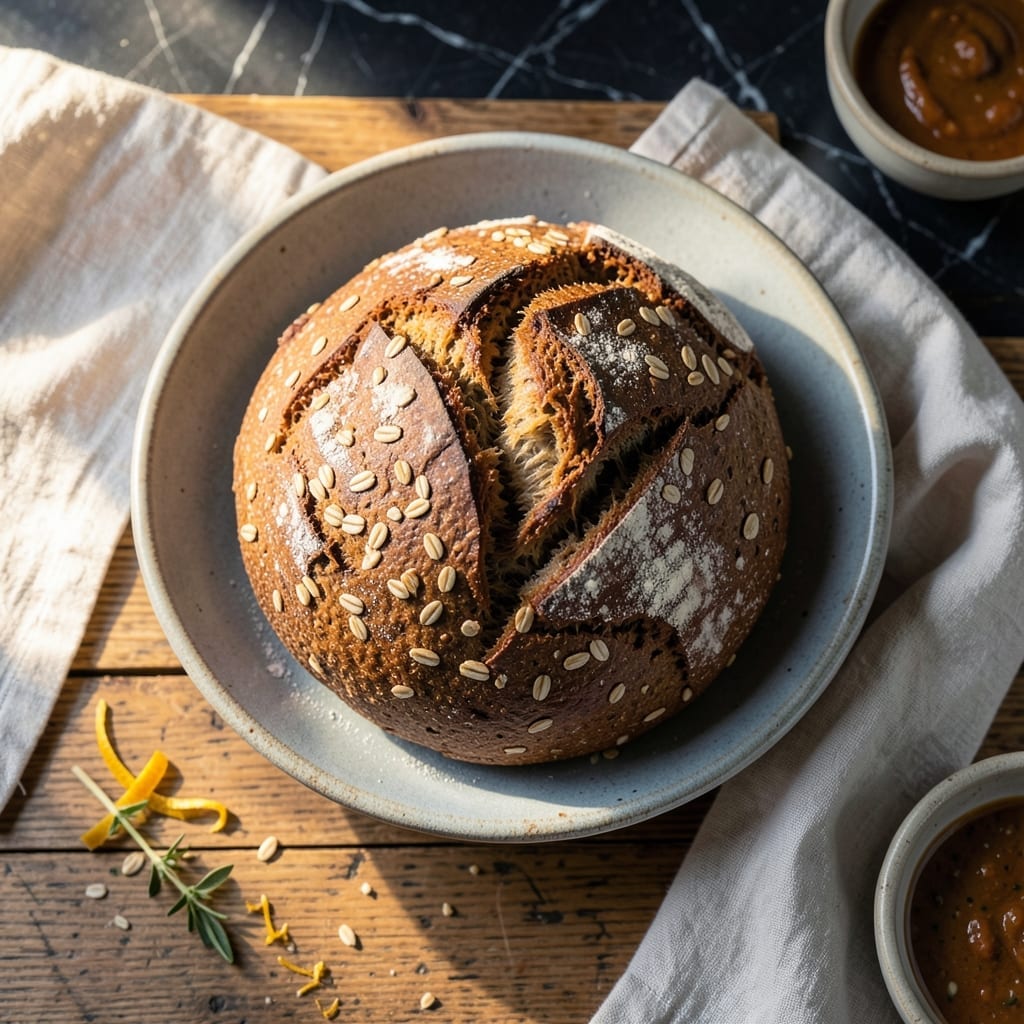
This traditional loaf brings authentic Irish flavor to your table with its dense, hearty texture and rich wholemeal taste.
Using simple ingredients, this proven method delivers a restaurant-quality bread that stays fresh for days.
Ingredients for Irish Brown Bread Recipe from Ireland
Simple, wholesome ingredients create this dense, hearty traditional loaf with authentic Irish character.
| Ingredient | Amount | Notes |
|---|---|---|
| Whole Wheat Flour 🌾 | 3 cups | Stone-ground preferred for texture |
| All-Purpose Flour 🌾 | 1 cup | Unbleached for best results |
| Old-Fashioned Rolled Oats 🥣 | 1 cup | Not instant or quick oats |
| Wheat Bran 🌾 | ½ cup | Adds density and fiber |
| Baking Soda 🧂 | 1 ½ tsp | Fresh for optimal rise |
| Salt 🧂 | 1 tsp | Fine sea salt preferred |
| Buttermilk 🥛 | 1 ¾ cups | Room temperature for best reaction |
| Unsalted Butter 🧈 | 2 tbsp | Melted and cooled slightly |
| Molasses 🍯 | 2 tbsp | Dark for robust flavor |
| Honey 🍯 | 1 tbsp | Optional for added sweetness |
The whole wheat flour is the foundation here. Stone-ground from a local mill or Bob’s Red Mill gives you that authentic texture and nutty flavor. Buttermilk is non-negotiable—it reacts with the baking soda for lift and tenderness. I always use full-fat buttermilk (trust me on this). Most supermarkets carry it, but if you’re in a pinch, mix whole milk with a splash of vinegar or lemon juice and let it sit for 10 minutes.
No buttermilk? Plain yogurt thinned with milk works in a ratio of 3:1. Swap molasses for dark brown sugar dissolved in warm water if that’s what’s in your pantry. The wheat bran can be omitted, but it adds that signature density—find it in the cereal aisle. If you want extra richness, replace the butter with an equal amount of melted coconut oil. The honey is optional but balances the molasses beautifully.
This bread stays fresh longer than most—wrap it tightly in beeswax wrap or foil and it’ll keep at room temperature for 4-5 days. For longer storage, slice and freeze for up to 3 months. Toast slices to revive that just-baked warmth.
Why You’ll Love This Recipe
- No Yeast Needed: I love that this comes together with just baking soda—no waiting for dough to rise.
- Nutty Crunch: The oats and wheat bran give it this hearty, earthy texture that’s just right with butter.
- Breakfast to Dinner: Honestly, it’s as good with morning jam as it is alongside stew at night.
- Pantry Staples: All-purpose flour, oats, wheat bran—chances are, I already have everything on hand.
Step-by-Step Instructions for Irish Brown Bread
Traditional technique ensures a dense, hearty loaf with authentic texture and flavor.
Step 1: Combine Dry Ingredients
In a large mixing bowl, whisk together the 3 cups Whole Wheat Flour, 1 cup All-Purpose Flour, 1 cup Old-Fashioned Rolled Oats, 0.5 cup Wheat Bran, 1.5 tsp Baking Soda, and 1 tsp Salt. This aerates the dry components while evenly distributing the leavening agent.
I always use a fine-mesh whisk for this step—it breaks up clumps in the Whole Wheat Flour and ensures the Baking Soda is completely incorporated. The mixture should appear uniformly speckled with the darker Wheat Bran and Oats.
Step 2: Create Wet Mixture
In a separate bowl, combine the 1.75 cups Buttermilk, 2 tbsp Unsalted Butter (melted and cooled), 2 tbsp Molasses, and 1 tbsp Honey. Whisk until the Molasses and Honey are fully dissolved into the Buttermilk.
The Buttermilk should be at room temperature to prevent the melted Butter from solidifying. I typically melt the Butter first and let it cool slightly while I measure the other wet ingredients. The mixture will appear slightly frothy with a rich caramel color from the Molasses.
Step 3: Form the Dough
Pour the wet mixture into the dry ingredients. Using a wooden spoon or silicone spatula, stir just until the flour is moistened and no dry pockets remain. The dough will be shaggy and slightly sticky—this is correct for traditional Irish Brown Bread.
Resist the urge to overmix. The moment the flour disappears into the liquid, stop stirring. Overworking develops gluten, which would make the bread tough rather than the desired dense, hearty texture. The dough should hold together when pressed but still look rough.
Step 4: Shape and Bake
Transfer the dough to a greased 8-inch round cake pan or line a similar pan with parchment paper. Press the dough evenly into the pan and smooth the top with wet hands—this prevents sticking and creates a uniform surface.
Using a sharp knife, cut a deep cross into the top of the dough (about ½ inch deep). This traditional scoring allows the bread to expand properly during baking. Bake at 375°F for 40-45 minutes until the loaf sounds hollow when tapped on the bottom and the top is deep golden brown.
Step 5: Cool Completely Before Slicing
Remove the bread from the pan immediately and transfer to a wire rack. Let it cool completely for at least 1 hour before slicing. This cooling period allows the interior to set properly—slicing too soon results in a gummy texture.
The bread should have a firm, dense crumb with a slightly crisp crust. The cross on top will have expanded into a rustic pattern. Serve at room temperature with butter or alongside hearty stews for an authentic Irish experience.
Pro Tips For Making Irish Brown Bread Recipe From Ireland
- Preheat Your Oven: I learned this the hard way—crank that oven to 400°F (200°C) and give it a full 15 minutes to heat evenly, otherwise your brown bread won’t rise properly.
- Soak the Oats: Mix the rolled oats with the buttermilk or water 10 minutes before combining with dry ingredients—sounds weird, but it softens them just enough for a better texture.
- Don’t Overmix: Stir just until the dough comes together, about 10-12 turns with a wooden spoon. Overworking it makes the bread dense and tough.
- Use Fresh Baking Soda: After a few flat loaves, I finally checked the expiration date on my baking soda. If it’s old, your bread won’t rise—swap it for a fresh box.
Serving Suggestions for This irish brown bread recipe from ireland
Breakfast Pairings
Start your day with thick slices toasted and slathered with Irish salted butter. The nutty, dense texture holds up beautifully to a fried egg on top. I love drizzling a bit of local honey over the warm bread for a sweet contrast. 💛
Soup Companions
This bread is the perfect partner for hearty soups. Serve with Irish lamb stew or a creamy potato leek soup—the bread’s density soaks up every last drop. I often warm slices in the oven for 5 minutes at 350°F before serving.
Cheese Board
Create an Irish-inspired board with sharp Dubliner cheddar, smoked salmon, and apple slices. The bread’s robust flavor stands up to strong cheeses. I add a small dish of whole grain mustard for dipping.
Sweet Treats
Transform leftovers into a dessert by toasting and topping with whipped cream and fresh berries. The molasses notes in the bread pair wonderfully with vanilla ice cream. My kids love this as an after-school snack.
Tea Time
Serve warm with a pot of Irish breakfast tea and a smear of clotted cream. The bread’s hearty texture makes it ideal for afternoon tea. I always slice it thick—about ¾ inch—for the best experience.
Preservation Tip
If serving later, wrap the loaf tightly in beeswax wrap once completely cooled. This keeps it fresh for 3-4 days at room temperature. For longer storage, freeze sliced portions in ziplock bags for up to 3 months. ✨
Frequently Asked Questions
Why is buttermilk essential for this bread?
Buttermilk reacts with baking soda to create lift without yeast. Its acidity also tenderizes the dense whole wheat flour for a perfect crumb.
Can I substitute the molasses?
Yes, use 2 tbsp dark brown sugar dissolved in 1 tbsp warm water. The flavor will be slightly milder but still delicious.
What’s the secret to a crisp crust?
Bake at 375°F until deep golden brown and hollow-sounding when tapped. Cool on a wire rack to prevent steam from softening it.
How do I know when it’s done?
A toothpick inserted in the center should come out clean. The top will be deep golden brown with a firm crust after 40-45 minutes.
Nutrition Facts

- BBQ Sausage Recipe Oven: Smoky Depth Without the Grill - September 28, 2026
- BBQ Chicken Bowl Recipe Rice: Smoky Sweetness Over Fluffy Grains - September 28, 2026
- Beef Cutlet Recipe Ideas: Crispy Breaded Patties With Bold Seasonings - September 28, 2026