
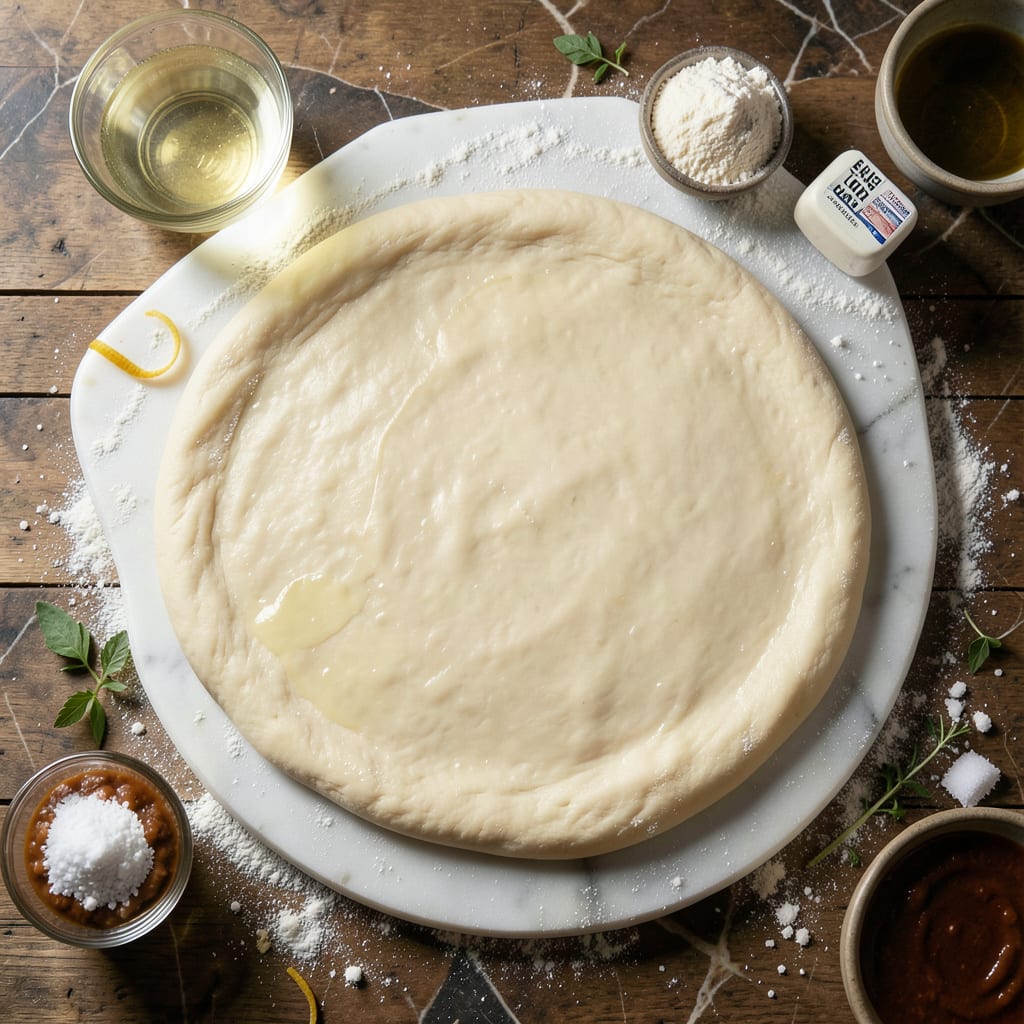
This proven method delivers a perfectly chewy yet crisp crust every time. The slow fermentation develops deep flavor while creating an airy texture that rivals any pizzeria.
With just a few basic ingredients and careful timing, you’ll achieve a golden, elastic dough that bakes up light and flavorful. This foundation ensures your pizza turns out exactly as it should.
Ingredients for Martha Stewart Pizza Dough
Eight ingredients create this golden, elastic dough that bakes up light and flavorful.
| Ingredient | Amount | Notes |
|---|---|---|
| Bread Flour 🌾 | 3 ½ cups | Plus extra for dusting |
| Active Dry Yeast 🍞 | 1 package | 2 1/4 tsp per package |
| Warm Water 💧 | 1 ¼ cups | 110-115°F for activation |
| Extra-Virgin Olive Oil 🫒 | 2 tbsp | Plus extra for bowl |
| Coarse Salt 🧂 | 2 tsp | Diamond Crystal preferred |
| Granulated Sugar 🍚 | 1 tsp | Feeds the yeast |
| Cornmeal 🌽 | ¼ cup | For dusting pan |
| All-Purpose Flour 🌾 | ½ cup | For adjustments if needed |
The flour matters here. King Arthur Bread Flour is the gold standard—higher protein content develops that chewy texture you want. Yeast freshness is non-negotiable; check the expiration date on the Fleischmann’s or Red Star packets. Warm water should feel like bathwater (not hot) to activate the yeast properly without killing it.
No bread flour? All-purpose plus 1 tbsp vital wheat gluten per cup gets you close. Out of yeast? This recipe won’t work without it—grab a packet from any grocery store. The olive oil can be any neutral oil in a pinch, but extra-virgin adds depth. Sugar is just to wake up the yeast; honey works too if that’s what you’ve got.
Dough can rest in the fridge for up to 3 days—it actually improves with time. Freeze portions for 1 month (thaw overnight in the fridge). Always bring dough to room temperature before shaping for best results.
Why You’ll Love This Recipe
- No-Fuss Rising: I love that this dough only needs one rise—just mix, let it sit, and it’s ready to roll.
- Rich Olive Oil Taste: The extra-virgin olive oil gives it this deep, savory richness that makes every bite satisfying.
- Endless Topping Options: I’ve used this base for everything from classic margherita to loaded veggie—it never lets me down.
- Budget-Friendly Staple: Bread flour and yeast are cheap, and this makes enough for two pizzas. Honestly, it’s my go-to for feeding a crowd without breaking the bank.
Step-by-Step Instructions for Pizza Dough
Here’s the method. Straightforward, tested, works every time.
Step 1: Activate the Yeast
In a large bowl, combine the 1.25 cups Warm Water, 1 tsp Granulated Sugar, and 1 package Active Dry Yeast. Let it sit for 5-7 minutes until the mixture becomes foamy on top. This confirms the yeast is alive and active.
The water should be between 110-115°F—too hot and it’ll kill the yeast, too cold and it won’t activate properly. I always use a thermometer for precision here. The sugar helps kickstart the yeast’s activity, giving you that perfect rise.
Step 2: Form the Dough
Add the 3.5 cups Bread Flour, 2 tsp Coarse Salt, and 2 tbsp Extra-Virgin Olive Oil to the yeast mixture. Stir with a wooden spoon until a shaggy dough forms. The salt strengthens the gluten development, while the olive oil adds richness and flexibility to the crust.
Turn the dough out onto a lightly floured surface (use some of the 0.5 cup All-Purpose Flour for dusting) and knead for 6-8 minutes until smooth and elastic. You’ll notice the dough transforms from sticky to silky as the gluten develops. If it’s too sticky, add a bit more of the all-purpose flour, 1 tablespoon at a time.
Step 3: First Rise
Lightly oil a large bowl with some Extra-Virgin Olive Oil and place the dough inside, turning to coat all sides. Cover with a damp towel and let rise in a warm, draft-free place for 1-2 hours or until doubled in size. I like to place mine near a slightly preheated oven for consistent warmth.
The dough is ready when it springs back slowly when poked with a finger. This rise develops the flavor and creates those beautiful air pockets in your crust. Don’t rush this step—proper rising is key to that perfect texture.
Step 4: Shape and Second Rise
Punch down the dough to release the air, then divide it into 4 equal portions for individual pizzas. Shape each portion into a smooth ball and place on a baking sheet dusted with 0.25 cup Cornmeal. The cornmeal adds texture and prevents sticking during baking.
Cover with a towel and let rest for 30 minutes. This second rise allows the dough to relax, making it easier to stretch without tearing. You’ll see the balls expand slightly during this time.
Step 5: Shape and Prepare for Toppings
Take one dough ball and press it gently with your fingertips on a cornmeal-dusted surface, working from the center outward. Stretch it to your desired thickness—I prefer about ¼-inch thick for a crisp yet chewy crust. Leave a slightly thicker rim for the crust.
Transfer to a baking sheet or pizza peel and add your toppings. The dough should be pliant and hold its shape without shrinking back. If it resists stretching, let it rest for another 5-10 minutes before trying again.
Pro Tips For Making Martha Stewart Pizza Dough
- Proof the Yeast: I learned this the hard way—always dissolve the active dry yeast in the warm water first and let it sit for 5-10 minutes until foamy. If it doesn’t bubble, your dough won’t rise, no matter how long you wait.
- Use Bread Flour: Sounds obvious, but all-purpose flour won’t give you that chewy, elastic crust. Bread flour’s higher protein content is what actually changes the outcome here.
- Skip Cold Water: Make sure your water is warm, around 110°F—too hot kills the yeast, too cold slows activation. I burned three batches before I finally got a thermometer.
- Oil the Bowl: After kneading, lightly coat the dough and the bowl with about 1 tablespoon of that extra-virgin olive oil before the first rise. It prevents sticking and makes the dough easier to handle later.
Common Mistakes When Making martha stewart pizza dough
Yeast Activation Errors
Using water that’s too hot (above 120°F) will kill your yeast instantly. Always check with a thermometer—110-115°F is the sweet spot. I learned this the hard way when my first batch never rose.
Over-Flouring Dough
Adding too much flour during kneading makes the dough tough. Dust your surface with just enough all-purpose flour to prevent sticking. The dough should remain slightly tacky to the touch.
Skipping the First Rise
Rushing the first rise results in a dense crust. Give it the full 1-2 hours in a warm spot. Patience here develops the flavor and airy texture we all want.
Improper Shaping
Stretching cold dough causes it to snap back. Always let it rest at room temperature for 30 minutes after dividing. Use your fingertips, not palms, to gently press from the center outward. 💡
Overloading Toppings
Too many toppings create a soggy crust. Stick to 3-4 toppings max and distribute them evenly. Less is truly more when it comes to pizza perfection.
Baking Temperature
Your oven needs to be screaming hot—475-500°F—for that perfect crisp. Preheat your baking stone or sheet for at least 30 minutes before baking. This mimics a wood-fired oven’s intense heat.
Nutrition Facts
Frequently Asked Questions
Can I use all-purpose flour instead of bread flour?
Yes, but add 1 tbsp vital wheat gluten per cup of all-purpose flour. This boosts protein content for better chew. The texture won’t be identical, but it’s a solid backup.
How long can the dough stay in the fridge?
Up to 3 days for best flavor and texture. Let it come to room temperature before shaping for easier stretching. Cold dough resists stretching.
Why didn’t my dough rise?
Old yeast or water that’s too hot are the usual culprits. Check expiration dates and use a thermometer—110-115°F is ideal. A quiet, warm spot helps too.
Can I make the dough in a stand mixer?
Use the dough hook on low speed for 6-8 minutes. It’s faster and less messy than hand-kneading. Just watch for proper gluten development.

- BBQ Sausage Recipe Oven: Smoky Depth Without the Grill - September 28, 2026
- BBQ Chicken Bowl Recipe Rice: Smoky Sweetness Over Fluffy Grains - September 28, 2026
- Beef Cutlet Recipe Ideas: Crispy Breaded Patties With Bold Seasonings - September 28, 2026