
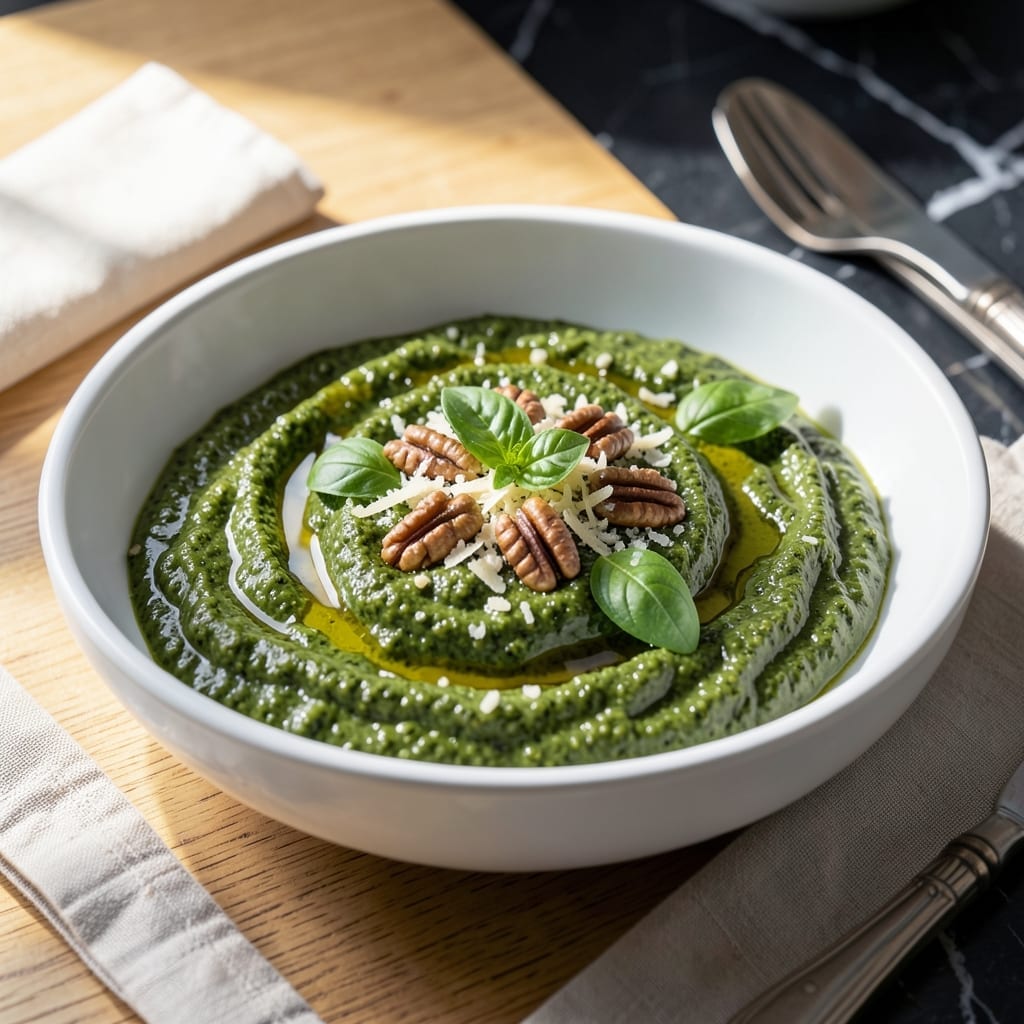
This pesto delivers the authentic Italian flavor you love without the traditional pine nuts. Walnuts step in as the perfect substitute, offering richness and texture that blend seamlessly with fresh basil and garlic.
The secret lies in toasting the walnuts first to bring out their natural oils, which creates a depth of flavor that complements the bright, herby notes of the basil. A touch of parmesan and pecorino adds the salty, umami backbone this sauce needs.
You’ll end up with a vibrant green pesto that’s creamy, aromatic, and versatile enough for pasta, sandwiches, or as a dip. The walnuts give it a subtle earthiness that makes it stand out while keeping the classic taste intact.
Store in an airtight container with a layer of oil on top to preserve its freshness for up to a week.
Ingredients for Pesto Recipe Without Pine Nuts
Nine simple ingredients create this rich, herby sauce with authentic Italian flavor.
| Ingredient | Amount | Notes |
|---|---|---|
| Fresh Basil Leaves 🌿 | 2 cups | Packed, stems removed |
| Walnuts 🥜 | ½ cup | Toasted for depth of flavor |
| Garlic Cloves 🧄 | 3 cloves | Peeled, rough chopped |
| Parmesan Cheese 🧀 | ½ cup | Freshly grated preferred |
| Pecorino Romano Cheese 🧀 | ¼ cup | Freshly grated for umami |
| Extra-Virgin Olive Oil 🫒 | ¾ cup | High quality, fruity |
| Lemon Juice 🍋 | 1 tbsp | Freshly squeezed for brightness |
| Salt 🧂 | ½ tsp | Sea salt preferred |
| Black Pepper 🌶️ | ¼ tsp | Freshly ground |
The walnuts are key here—toast them first to unlock their oils and depth. Fresh basil (the good stuff, not the pre-packaged kind with wilted leaves) makes all the difference. I grab mine from the farmers market when it’s in season. Both Parmesan and pecorino add layers of salty, umami goodness. Whole Foods or Trader Joe’s have great blocks for grating fresh.
No walnuts? Pecans or almonds work just as well (toast them too). Short on fresh basil? Stretch it with spinach (up to half and half). Out of pecorino? Double the Parmesan—still delicious. The olive oil should be something you’d drizzle on good bread. Skip the pre-grated cheese; it’s coated in anti-caking agents and doesn’t melt the same.
Pesto oxidizes fast, so pour a thin layer of olive oil on top before sealing. Keeps in the fridge for 1 week (the intro’s tip) or freeze in ice cube trays for 3 months. Perfect for pasta, sandwiches, or as a dip.
Why You’ll Love This Recipe
- 5-Minute Blend: I toss everything in the food processor and it’s done before the pasta finishes boiling.
- Nutty Richness: The walnuts add a deep, buttery crunch that’s even better than pine nuts.
- Pasta to Pizza: I slather it on sandwiches one day, stir it into pasta the next.
- Cheaper Luxury: Swapping pine nuts for walnuts cuts the cost but keeps that gourmet punch.
Step-by-Step Instructions for Basil and Walnut Pesto
This method preserves the authentic flavor while making the most of your walnuts and fresh basil.
Step 1: Toast the Walnuts for Depth
Heat a dry skillet over medium heat. Add the 0.5 cup Walnuts and toast for 4-5 minutes, stirring frequently, until they turn golden brown and smell fragrant. Watch them closely—they burn easily.
This toasting step is non-negotiable for authentic flavor. It brings out the natural oils and adds a deep, nutty richness that replaces what you’d normally get from pine nuts. Transfer the toasted walnuts to a plate to cool completely before blending.
Step 2: Pulse the Aromatics and Cheese
In a food processor, combine the 2 cups Fresh Basil Leaves, 3 cloves Garlic Cloves, 0.5 cup Parmesan Cheese, and 0.25 cup Pecorino Romano Cheese. Pulse in 2-second bursts for about 10-12 seconds total until finely chopped but not pureed.
I’ve found that pulsing (rather than continuous blending) gives you better texture control. The mixture should look like coarse sand with some larger flecks. The garlic should be completely minced, and the cheeses should be evenly distributed throughout the basil.
Step 3: Add Walnuts and Begin Emulsifying
Add the cooled 0.5 cup Walnuts to the food processor. Pulse again for 5-6 seconds until the nuts are finely ground and incorporated into the basil mixture. The texture should still have some body to it—don’t over-process into a paste.
At this point, your mixture will look dry and crumbly. That’s exactly what you want before adding the liquid ingredients. The walnuts should be finely chopped but still visible as small pieces throughout the mixture.
Step 4: Stream in the Olive Oil and Seasonings
With the food processor running continuously, slowly pour in the 0.75 cup Extra-Virgin Olive Oil through the feed tube. Process for 20-30 seconds until the mixture comes together into a thick, creamy paste. Stop and scrape down the sides as needed.
Add the 1 tbsp Lemon Juice, 0.5 tsp Salt, and 0.25 tsp Black Pepper. Pulse a few more times to incorporate completely. The lemon juice brightens the flavors, while the salt and pepper enhance the natural tastes of the basil and cheeses.
The finished pesto should be thick but pourable, with a vibrant green color and a glossy sheen from the olive oil. If it’s too thick, add a little more olive oil, 1 tablespoon at a time, until it reaches your desired consistency.
Pro Tips For Making Pesto Recipe Without Pine Nuts
- Blanch the Basil: I learned this the hard way—tossing basil leaves in boiling water for 10 seconds then shocking in ice water keeps them vibrant green and prevents bitterness in your pesto.
- Toast the Walnuts: Spread walnuts on a dry pan over medium heat for 3-4 minutes until fragrant—this deepens their flavor and balances the sharpness of the pecorino.
- Skip the Garlic Overload: After ruining a batch with too much garlic, I now stick to 1 clove max for 2 cups of basil—raw garlic overpowers the delicate basil and nut flavors.
- Grate Cheese Fresh: Sounds tedious, but freshly grated parmesan and pecorino melt into the pesto better than pre-shredded, which has anti-caking agents that make the texture grainy.
Essential Equipment for This Dish
Food Processor Essentials
A 7-11 cup food processor is your best friend here—I use my Cuisinart DFP-14BCNY for perfect texture every time. Look for one with a sharp S-blade and a feed tube for streaming oil. The motor should be at least 500 watts to handle nuts and cheese without straining.
Quality Blender Alternative
If you don’t own a food processor, a high-powered blender like Vitamix works too. Use the tamper to push ingredients toward the blade. Pulse instead of continuous blending to avoid overheating the basil, which can turn it bitter. 💡
Cheese Grater Matters
Freshly grated cheese makes a huge difference in texture and flavor. I swear by my Microplane for the hardest cheeses like pecorino. For Parmesan, a box grater with medium holes gives the right consistency. Pre-grated just won’t melt the same.
Skillet for Toasting
A heavy-bottomed stainless steel skillet (I use All-Clad) is ideal for toasting walnuts evenly. Avoid non-stick for this step—you want direct heat contact. A 10-inch skillet gives enough room to stir without crowding.
Storage Containers
Glass jars with airtight lids are perfect for storing pesto. I love Ball Mason jars—they’re easy to clean and let you see the vibrant green color. Leave ½ inch headspace at the top for the oil layer that preserves freshness. ❄️
Measuring Tools
Precision matters with strong flavors like garlic and salt. Use measuring spoons for small quantities and a liquid measuring cup for oil. I keep a set of OXO Good Grips measuring cups in my drawer—they’re comfortable and accurate.
Nutrition Facts
Frequently Asked Questions
Can I use other nuts instead of walnuts?
Pecans or almonds work beautifully as substitutes. Toast them first to enhance their natural oils and achieve the best flavor.
How long will this pesto stay fresh?
Stored in an airtight container with a thin layer of olive oil on top, it keeps for 1 week in the fridge. For longer storage, freeze in ice cube trays for up to 3 months.
Can I make this without a food processor?
Yes, a high-powered blender works too. Pulse the ingredients instead of continuous blending to avoid overheating the basil, which can make it bitter.
Why toast the nuts first?
Toasting brings out the natural oils and adds depth of flavor. It replaces the richness pine nuts provide, ensuring your pesto still tastes authentic.

- Pav Bhaji Recipe Food Lab: Mumbai Street Food Magic at Home - October 6, 2026
- Peach Jelly Recipe Without Pectin: Naturally Set Sweet Spread - October 6, 2026
- Pasta Salad Recipe With Zesty Italian Dressing: Bright Herb-Kissed Medley for Picnics - October 6, 2026