
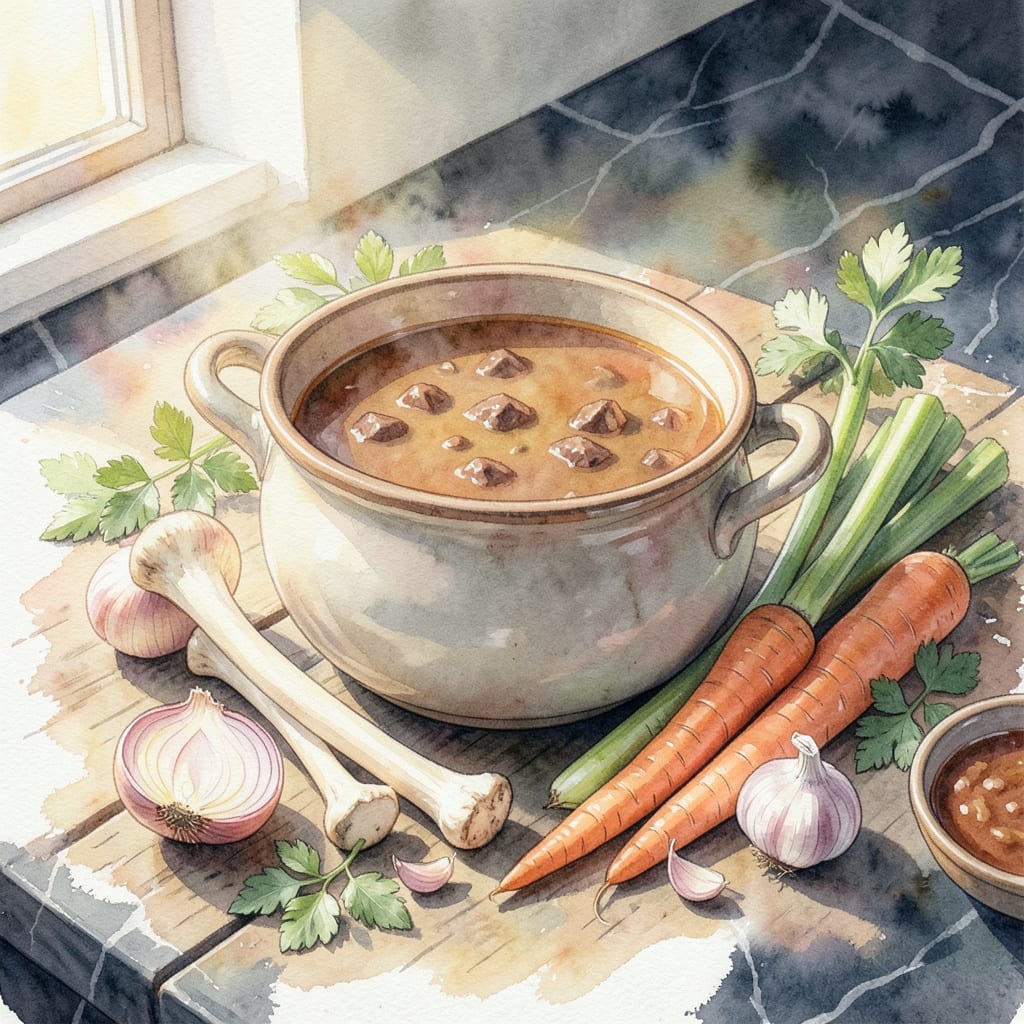
Homemade beef stock transforms the foundation of countless dishes with its rich, deep flavor that store-bought versions simply can’t match. This simmered broth extracts maximum gelatin and complexity from bones and aromatics.
The slow cooking process breaks down collagen into silky gelatin, creating a stock that coats your spoon. I’ve refined this method over years of professional kitchens and home cooking, ensuring consistent results every time.
This liquid gold will elevate your sauces, soups, and braises with layers of savory depth. The key is patience—low heat and time extract flavors that quick methods miss.
Make a large batch and freeze in portions for whenever your recipes call for that extra boost of flavor. Here’s how to create this essential kitchen staple.
Ingredients for Recipe Beef Stock
Ten ingredients for liquid gold that beats any canned or boxed version.
| Ingredient | Amount | Notes |
|---|---|---|
| Beef Bones 🥩 | 4 lb | Marrow and knuckle preferred |
| Onions 🧅 | 2 whole | Quartered, skin on |
| Carrots 🥕 | 3 whole | Cut into large chunks |
| Celery Stalks 🌿 | 3 whole | Cut into large chunks |
| Garlic Cloves 🧄 | 6 cloves | Smashed, skin on |
| Tomato Paste 🍅 | 2 tbsp | For depth and color |
| Bay Leaves 🍃 | 2 whole | Dried, whole leaves |
| Black Peppercorns 🌶️ | 1 tbsp | Whole, lightly crushed |
| Fresh Thyme Sprigs 🌿 | 4 whole | Tied with twine |
| Cold Water 💧 | 6 cups | Enough to cover bones |
The bones are everything here. Ask your butcher for marrow and knuckle bones—they’re packed with collagen that turns into that silky gelatin. I get mine from Whole Foods or a local butcher (they’ll often give you bones for free if you ask nicely). Roast them first for deeper flavor—skip this step and your stock will taste flat. The veggies? Organic if possible, but regular works fine too.
No tomato paste? A splash of red wine adds similar depth. Out of fresh thyme? Dried thyme at one-third the amount works in a pinch. If you don’t have bay leaves, skip it—don’t use ground bay. The peppercorns can be pre-ground if that’s all you’ve got, but whole tastes fresher. And if you’re short on bones, chicken bones work too (just reduce the water a bit).
Stock freezes like a dream. Portion into 1-cup containers or ice cube trays for easy use. Keeps in the fridge for 4-5 days, in the freezer for 6 months. Skim the fat after chilling—it’ll rise to the top and solidify. That’s it. Simple, but worth every minute.
Why You’ll Love This Recipe
- Set It and Forget: I toss the beef bones, onions, carrots, and celery into the pot, then let the slow cooker do all the work.
- Rich and Deep: The roasted garlic and beef bones create a flavor so robust it makes every soup and stew taste like it simmered for days.
- Endless Uses: I use this stock for everything—gravies, braises, even cooking rice. It’s my kitchen’s secret ingredient.
- Penny-Wise Pound-Foolish: Honestly, it costs almost nothing to make but saves me a fortune compared to store-bought. Plus, I control the salt.
Step-by-Step Instructions for Beef Stock
Here’s the method I swear by for a deeply flavored stock that’s rich and aromatic.
Step 1: Roast the Beef Bones and Vegetables
Preheat your oven to 400°F. Spread the 4 lb Beef Bones on a rimmed baking sheet. Roast for 30-40 minutes until they’re deeply browned—this develops the rich, caramelized flavors that define a great stock.
Meanwhile, add the 2 whole Onions, 3 whole Carrots, and 3 whole Celery Stalks to another baking sheet. Roast these for 20-25 minutes until the onions start to char slightly at the edges. Roasting intensifies their sweetness and adds depth to your finished stock.
Step 2: Combine and Deglaze in the Stockpot
Transfer the roasted beef bones and vegetables to a large stockpot. Add the 6 cloves Garlic Cloves, 2 tbsp Tomato Paste, 2 whole Bay Leaves, 1 tbsp Black Peppercorns, and 4 whole Fresh Thyme Sprigs.
Place the stockpot over medium-high heat and add 1 cup of the 6 cups Cold Water to deglaze, scraping up all those delicious browned bits from the bottom of the pot. These fond bits are pure flavor and will dissolve into your stock as it simmers.
Step 3: Simmer Gently for Maximum Flavor Extraction
Pour in the remaining 5 cups Cold Water until the beef bones are completely submerged. Bring to a boil, then immediately reduce to a gentle simmer. You should see just a few bubbles breaking the surface—not a rolling boil, which can make your stock cloudy.
Partially cover the pot and let it simmer for 4-6 hours. Skim off any foam or fat that rises to the top during the first hour of simmering. The longer you simmer, the more gelatin and flavor you’ll extract from the beef bones, resulting in a richer, more body in your final stock.
Step 4: Strain and Store Your Finished Stock
After simmering, remove the stockpot from heat and let it sit for 10-15 minutes to allow the solids to settle. Then, carefully strain the stock through a fine-mesh sieve into a clean container, pressing gently on the solids to extract all the liquid but not so hard that you force bits through the sieve.
Let the stock cool to room temperature, then refrigerate. Once chilled, the fat will solidify on the surface, making it easy to remove. Your stock will keep in the refrigerator for 4-5 days or can be frozen for up to 3 months for future use in soups, sauces, and braises.
Pro Tips For Making Recipe Beef Stock
- Roast the Bones First: I learned this the hard way—raw bones make a flat stock. Toss them in a 400°F oven for 30-40 minutes until deeply browned; it adds layers of flavor you can’t get from simmering alone.
- Skip the Peeling: Sounds weird, but it works: leave the skins on your onions and garlic. They add natural pectin that gives the stock a richer mouthfeel, and you’ll save 10 minutes of prep time.
- Keep It Gentle: After burning a batch from a rolling boil, I finally figured out that a slow, steady simmer (barely bubbling) is non-negotiable. Anything hotter turns the stock cloudy and bitter.
- Strain Through Cheesecloth: This isn’t the prettiest method, but it’s the tastiest. Line your strainer with cheesecloth to catch the fine impurities that make stock look murky—does it look weird? Yes. Does it work? Every single time.
Serving Suggestions for This Dish
Soups and Stews
Use this as the base for French onion soup—it adds a depth that canned broth can’t match. I also love it in beef stew, where the gelatin helps thicken the sauce naturally. The rich flavor stands up to hearty ingredients like potatoes and carrots. 🥘
Sauce Foundation
Reduce 2 cups of this stock by half to create an intense base for pan sauces after searing meats. It’s also perfect for gravy—just whisk in a roux made with 2 tbsp butter and 2 tbsp flour. The results will be restaurant-quality every time.
Rice and Grains
Cook 1 cup rice in this stock instead of water for a flavor boost. I use it for risotto too—the slow addition of warm stock builds layers of taste. It works wonderfully with quinoa or barley as well.
Braising Liquid
For pot roast or short ribs, replace water with this stock in your braising liquid. Add 1 cup red wine and 1 tbsp balsamic vinegar for extra complexity. The meat will be fall-off-the-bone tender with incredible depth.
Pasta Cooking
Boil pasta in this stock for an extra flavor dimension. I particularly love it with fresh egg noodles or gnocchi. Just
Sipping Broth
Strain and season with sea salt and a squeeze of lemon juice for a comforting sipping broth. It’s nourishing and perfect for cold days. I like to add a dash of hot sauce for a little kick.
Nutrition Facts
Frequently Asked Questions
How long can I store homemade stock in the fridge?
It keeps for 4-5 days in the refrigerator. For longer storage, freeze it in 1-cup portions for up to 3 months.
Why did my stock turn out cloudy?
A rolling boil can make it murky. Keep it at a gentle simmer and skim foam regularly. Also, avoid pressing solids when straining.
Can I use chicken bones instead of beef?
Yes, but reduce water slightly. Chicken bones create a lighter stock with less gelatin. For mixed flavor, use 50/50 beef and chicken bones.
Do I need to blanch the bones first?
Not required, but blanching for 5-10 minutes removes impurities for a cleaner flavor. Rinse well after blanching before roasting.

- Bread Recipe KitchenAid Mixer: Foolproof Loaf With Perfect Rise - September 28, 2026
- BBQ Oysters Recipe Grill: Smoky Garlic Butter Bliss - September 28, 2026
- Crock Pot Mac and Cheese Recipe Paula Deen: Ultra Creamy Southern-Style Comfort - September 28, 2026