
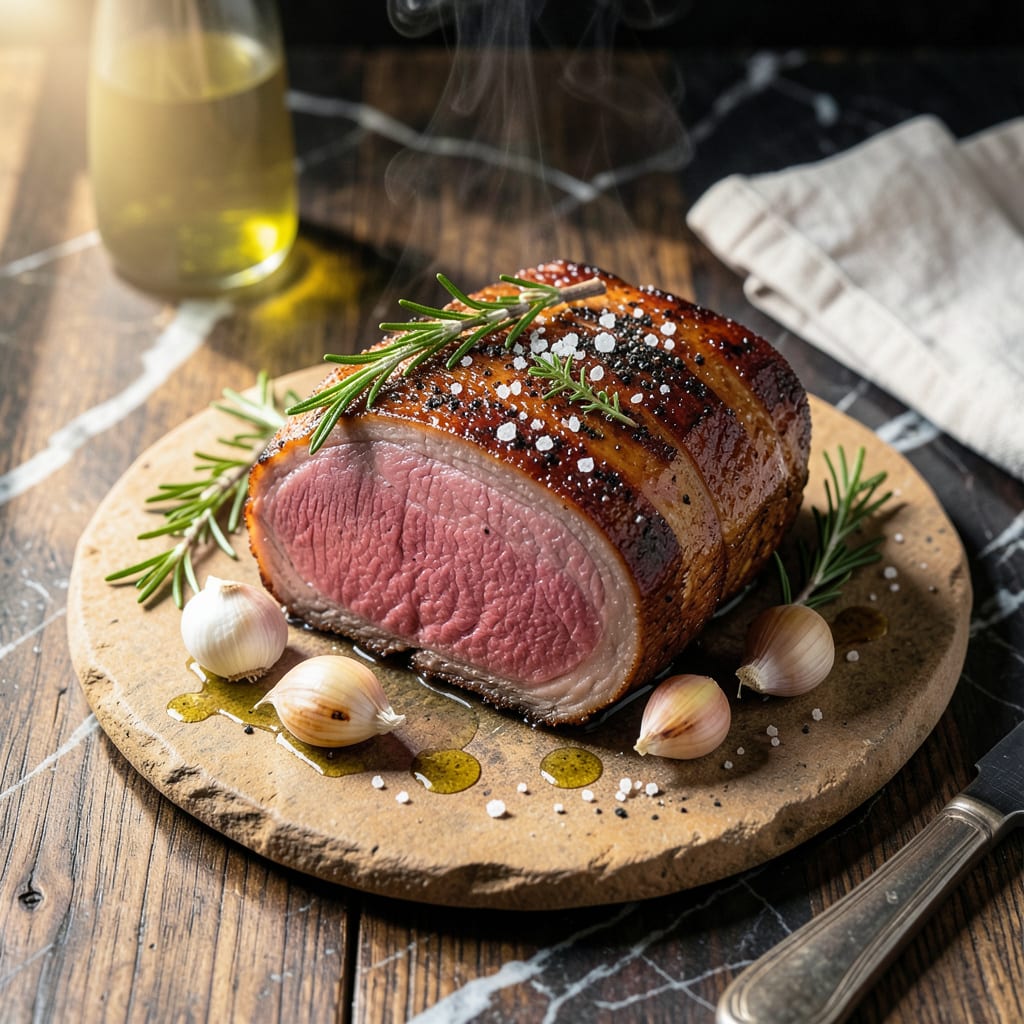
This method delivers perfectly even cooking from edge to edge, with a tender center every time. The reverse sear starts low in the oven, then finishes with a high-heat sear for an ideal crust.
No more overcooked edges or raw centers. The beef tenderloin emerges juicy throughout with a deeply browned exterior, ready to impress at any dinner table.
Ingredients for Reverse Sear Beef Tenderloin
A few premium ingredients deliver restaurant-quality results with precise control over doneness.
| Ingredient | Amount | Notes |
|---|---|---|
| Beef Tenderloin 🥩 | 2 lb | Center-cut, trimmed of excess fat |
| Kosher Salt 🧂 | 1 ½ tbsp | Diamond Crystal preferred for even seasoning |
| Freshly Ground Black Pepper 🌶️ | 1 tbsp | Coarse grind for texture |
| Garlic Cloves 🧄 | 4 cloves | Smashed, peeled, halved |
| Fresh Rosemary Sprigs 🌿 | 4 sprigs | Woody stems removed |
| Fresh Thyme Sprigs 🍃 | 4 sprigs | Woody stems removed |
| Extra-Virgin Olive Oil 🫒 | 2 tbsp | High smoke point variety |
| Unsalted Butter 🧈 | 2 tbsp | European-style for richness |
| Shallot 🧅 | 1 whole | Finely minced for flavor base |
| Red Wine 🍷 | ½ cup | Dry variety like Cabernet Sauvignon |
| Beef Stock 🥣 | ½ cup | Low-sodium preferred |
| Dijon Mustard 🟡 | 1 tbsp | For crust enhancement |
The beef tenderloin is non-negotiable here. Center-cut pieces ensure even thickness for consistent cooking. Source from a reputable butcher or Whole Foods for quality. Look for vibrant red color and good marbling—this guarantees tenderness. The Diamond Crystal kosher salt is a professional standard; its flake structure adheres better to the meat surface.
No fresh herbs? Dried rosemary and thyme at one-third the amount work in a pinch, but fresh delivers superior aroma. Substitute shallot with yellow onion if necessary, though the flavor profile will be slightly different. For the wine, any bold dry red works—Merlot or Pinot Noir are acceptable. The beef stock can be replaced with mushroom stock for a vegetarian alternative, though this is a beef-focused dish.
Store raw tenderloin in the coldest part of your refrigerator for up to 3 days. Once cooked, leftovers keep for 4-5 days in an airtight container. The herb-infused butter can be prepped ahead and stored in the freezer for up to 1 month.
Why You’ll Love This Recipe
- Set It and Forget: I toss the tenderloin in the oven, let the low heat do its magic, then a quick sear—no babysitting required.
- Garlic-Rosemary Crust: The salt, pepper, garlic, and rosemary form this insane crust that cracks with every slice. Ridiculously good.
- Sunday or Tuesday: Honestly, I serve this for holiday dinners and random weeknights alike. Always feels special, never feels like work.
- Leftovers for Days: One roast feeds us twice—sandwiches the next day taste even better, and that’s saying something.
Step-by-Step Instructions for Reverse Sear Beef Tenderloin
This method guarantees an even medium-rare center with a deeply browned, flavorful crust every time.
Step 1: Season and Slow-Roast the Beef Tenderloin
Pat the 2 lb Beef Tenderloin completely dry with paper towels, then rub it all over with the 1.5 tbsp Kosher Salt and 1 tbsp Freshly Ground Black Pepper. The seasoning should adhere evenly to every surface, including the ends. Place the tenderloin on a wire rack set over a baking sheet.
Preheat your oven to 250°F. Roast the beef until the internal temperature reaches 115-120°F on an instant-read thermometer, about 45-60 minutes depending on thickness. This low-and-slow approach ensures the center cooks evenly without overcooking the outer layers.
Step 2: Prepare the Aromatic Baste
While the beef roasts, finely mince the 1 whole Shallot and smash the 4 cloves Garlic Cloves. Strip the leaves from the 4 sprigs Fresh Rosemary Sprigs and 4 sprigs Fresh Thyme Sprigs, discarding the woody stems. Combine these with the 2 tbsp Extra-Virgin Olive Oil in a small bowl.
In a separate small saucepan, melt the 2 tbsp Unsalted Butter over low heat. Stir in the 1 tbsp Dijon Mustard until fully incorporated. This will be brushed onto the beef during searing for an extra layer of flavor and crust development.
Step 3: Sear to Develop a Deep Crust
Heat a heavy skillet or cast-iron pan over high heat until extremely hot. Add the 2 tbsp Extra-Virgin Olive Oil from your aromatic mix and swirl to coat. Carefully place the beef tenderloin in the pan—it should sizzle immediately. Sear for 2-3 minutes per side until deeply browned.
Baste the beef continuously with the melted butter and mustard mixture, along with the minced shallot, garlic, rosemary, and thyme. Use a spoon to pour the hot butter over the top and sides repeatedly. The exterior should develop a rich, dark crust by the time the internal temperature reaches 125-130°F for medium-rare.
Step 4: Rest and Prepare the Pan Sauce
Transfer the seared beef to a cutting board and tent loosely with foil. Let it rest for 10-15 minutes—this allows the juices to redistribute for maximum tenderness. The internal temperature will rise by 5-10 degrees during resting, reaching the ideal 130-135°F for medium-rare.
Pour out excess fat from the skillet, then place it over medium heat. Add the minced shallot and any remaining garlic or herbs, cooking for 30 seconds until fragrant. Deglaze with the 0.5 cup Red Wine, scraping up browned bits. Simmer until reduced by half, then add the 0.5 cup Beef Stock and simmer for 2-3 minutes until slightly thickened. Strain and serve with the sliced beef.
Pro Tips For Making Reverse Sear Beef Tenderloin
- Start Low and Slow: Cook the tenderloin in a 225°F oven until it hits 110°F internally—I learned this the hard way after overcooking it at higher temps. This guarantees even doneness before the sear.
- Dry the Surface: Pat the beef completely dry with paper towels before seasoning. Sounds obvious, but wet meat steams instead of searing, and you’ll lose that crust.
- Skip Cold Meat: Pull the tenderloin from the fridge at least 1 hour before cooking. I used to rush this and ended up with uneven edges—room temp guarantees consistent cooking.
- Crush the Garlic: Smash the garlic cloves lightly with the side of your knife before adding them to the pan. It releases more flavor without burning, and the aroma is worth the extra 10 seconds.
Essential Equipment for reverse sear beef tenderloin
Precision Thermometer
A reliable instant-read thermometer is non-negotiable for reverse searing. I use a ThermoWorks ThermoPop for its accuracy and speed. It reads temperatures in 3-4 seconds, which is crucial when tracking the internal temperature during both the oven and searing phases.
Oven-Safe Rack
Elevating the beef on a wire rack during the slow roast ensures even air circulation for consistent cooking. I recommend a stainless steel rack placed over a baking sheet to catch any drippings. This setup prevents the bottom from steaming and promotes a uniform texture.
Heavy Skillet
A cast-iron skillet is ideal for the searing phase—it retains heat beautifully and develops a superior crust. My go-to is a Lodge 12-inch skillet, which provides ample space for basting. Preheat it for at least 5 minutes to achieve the high heat needed for a perfect sear.
Basting Tools
Use a heat-resistant silicone brush or a large spoon for basting the beef with the butter-herb mixture. This ensures even distribution of flavors and helps build that rich, browned crust. I keep a dedicated brush just for this purpose to avoid any cross-contamination.
Resting Setup
After searing, transfer the beef to a wooden cutting board and tent it loosely with aluminum foil. This allows the meat to rest while keeping it warm. The juices redistribute during this 10-15 minute period, guaranteeing a moist and tender result. 🔥
Pan Sauce Essentials
For the pan sauce, a wooden spoon is perfect for scraping up the browned bits. A fine-mesh strainer helps remove any solid pieces, leaving a smooth, flavorful sauce. I use a OXO Good Grips strainer—it’s sturdy and easy to clean.
Nutrition Facts
Frequently Asked Questions
Why use a low oven temperature first?
Starting at 250°F ensures even cooking throughout the thick cut. This method prevents a burnt exterior while the center reaches the perfect 115-120°F before searing.
Can I use a different cut of beef?
While tenderloin works best, you can use ribeye or strip steak. Adjust cooking time based on thickness, and always aim for an internal temp of 125-130°F before searing.
How do I avoid overcooking during searing?
Use an instant-read thermometer and sear for only 2-3 minutes per side. Remove the beef when it hits 125°F—it will rise to 130-135°F while resting.
Is resting really necessary?
Yes! Resting for 10-15 minutes lets juices redistribute. Skipping this step can leave your beef dry, even if cooked perfectly.

- BBQ Sausage Recipe Oven: Smoky Depth Without the Grill - September 28, 2026
- BBQ Chicken Bowl Recipe Rice: Smoky Sweetness Over Fluffy Grains - September 28, 2026
- Beef Cutlet Recipe Ideas: Crispy Breaded Patties With Bold Seasonings - September 28, 2026