
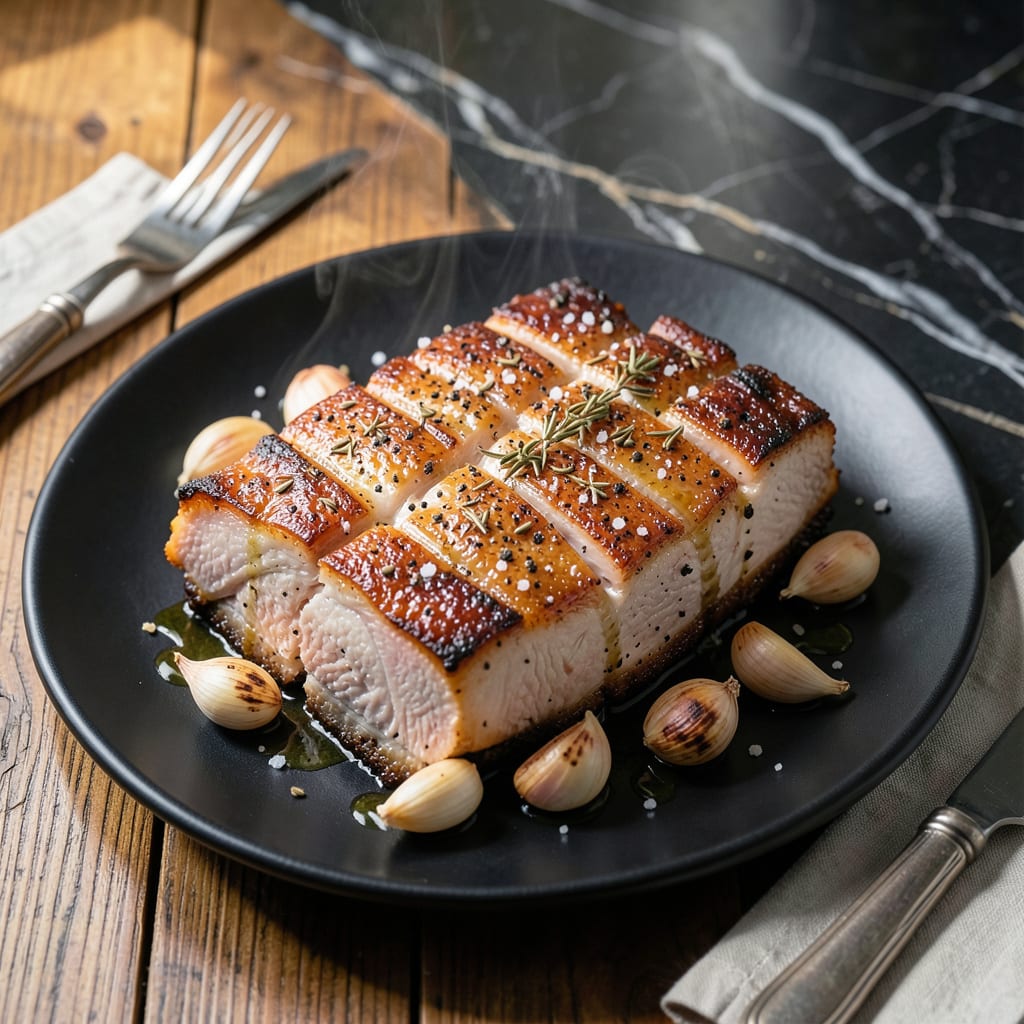
Achieving meltingly tender pork belly with perfectly crisp skin requires patience and precision. This method delivers restaurant-quality results through a low-and-slow approach.
The slow roasting process transforms the fat into buttery richness while creating shatteringly crisp crackling. Each bite offers the ideal contrast of textures that defines exceptional pork belly.
Ingredients for Slow Roasted Pork Belly
Restaurant-quality pork belly starts with these carefully selected ingredients for optimal texture and flavor.
| Ingredient | Amount | Notes |
|---|---|---|
| Pork Belly 🥓 | 2 lb | Skin-on, uniform thickness |
| Kosher Salt 🧂 | 1 tbsp | Diamond Crystal preferred |
| Black Pepper 🌶️ | 1 tsp | Freshly ground for best flavor |
| Fennel Seeds 🌿 | 1 tsp | Lightly crushed for aroma |
| Dried Thyme 🍃 | 1 tsp | Rubbed between fingers to release oils |
| Garlic Cloves 🧄 | 6 cloves | Minced for even distribution |
| Fresh Rosemary Sprigs 🌿 | 3 whole | Leaves stripped and chopped |
| Apple Cider Vinegar 🍏 | 2 tbsp | For skin crisping |
| Olive Oil 🫒 | 1 tbsp | Extra-virgin for richness |
| Honey 🍯 | 2 tbsp | For glazing the skin |
| Dijon Mustard 🥄 | 1 tbsp | Smooth variety preferred |
The pork belly is the foundation—look for skin-on, even thickness at your butcher or Whole Foods. Avoid pre-cut pieces with uneven fat distribution, as this affects cooking consistency. Diamond Crystal kosher salt is ideal for its clean flavor and precise grain size. Freshly ground black pepper and crushed fennel seeds add depth without overpowering the natural richness of the pork.
No fresh rosemary? Dried rosemary at half the amount works, but soak it in warm water for 10 minutes to rehydrate. Apple cider vinegar can be swapped with white vinegar or lemon juice for the skin crisping step. For a different glaze, maple syrup replaces honey one-to-one. The garlic and thyme are flexible—use powdered if fresh isn’t available, but reduce by one-third.
Store pork belly in the fridge for up to 3 days before cooking, or freeze for 6 months. Once roasted, leftovers keep for 4 days refrigerated. Reheat in the oven to maintain crisp skin—microwaving will soften it. Prep the dry rub the night before to let flavors meld.
Why You’ll Love This Recipe
- Set It and Forget: I just rub the pork belly with salt, pepper, fennel, and thyme, then let the oven do the work for hours.
- Crispy, Herby Bliss: That slow-roasted skin gets impossibly crisp while the fennel and thyme infuse every bite with warmth.
- Dinner or Leftovers: It’s just as good fresh out of the oven as it is cold on a sandwich the next day.
- Budget Crowd-Pleaser: Pork belly is affordable, and this one dish feeds a table with minimal effort from me.
Step-by-Step Instructions for Slow Roasted Pork Belly
Master the technique that delivers melt-in-your-mouth meat with perfectly crisp skin every time.
Step 1: Prepare and Cure the Pork Belly
Begin by patting the 2 lb Pork Belly dry with paper towels, ensuring the skin is completely free of moisture. This is critical for achieving that coveted crackling texture later. Using a sharp knife, score the skin in a crosshatch pattern, cutting just through the fat cap without piercing the meat beneath.
In a small bowl, combine the 1 tbsp Kosher Salt, 1 tsp Black Pepper, 1 tsp Fennel Seeds, and 1 tsp Dried Thyme. Rub this mixture evenly over the entire surface of the pork belly, including the scored skin and all sides. The salt will penetrate the meat, ensuring seasoning throughout while the spices infuse their aromatic qualities.
Step 2: Apply the Aromatic and Acidic Base
Finely mince the 6 cloves Garlic Cloves and chop the leaves stripped from the 3 whole Fresh Rosemary Sprigs. In a separate bowl, whisk together the 2 tbsp Apple Cider Vinegar, 1 tbsp Olive Oil, 2 tbsp Honey, and 1 tbsp Dijon Mustard until the honey fully dissolves into the liquid.
This mixture serves a dual purpose: the acidity from the vinegar and mustard helps tenderize the meat while the honey and oil create a sticky base for the aromatics to cling to. Spread this mixture evenly over the pork belly, then press the minced garlic and chopped rosemary onto the surface, ensuring they adhere well to the meat and skin.
Step 3: Slow Roast for Maximum Tenderness
Preheat your oven to 275°F. Place the pork belly skin-side up on a wire rack set over a rimmed baking sheet. This elevation allows air to circulate around the entire piece, promoting even cooking and preventing the bottom from steaming in its own juices.
Roast for 2 hours, then increase the oven temperature to 425°F and continue roasting for an additional 30-45 minutes. The initial low-and-slow phase renders the fat and breaks down the collagen, resulting in that meltingly tender texture. The final high-heat blast is what transforms the scored skin into an audibly crisp crackling.
Step 4: Rest and Serve
Remove the pork belly from the oven and transfer it to a cutting board. Tent loosely with foil and let it rest for 15-20 minutes. This resting period allows the juices to redistribute throughout the meat, ensuring each slice remains moist and flavorful rather than dry at the edges.
To serve, cut the pork belly into 1-inch thick slices using a sharp chef’s knife. The ideal result features a crisp, caramelized skin that gives way to layers of rich, tender meat beneath. The interior should be soft enough to cut with minimal resistance, while the exterior offers a satisfying crunch with every bite.
Pro Tips For Making Slow Roasted Pork Belly
- Score the Skin: Use a sharp knife to cut 1/4-inch deep slits across the fat cap before seasoning—this lets the salt and spices penetrate while helping the fat render out evenly.
- Start Hot, Finish Low: Roast at 425°F for 30 minutes first to get that crackling skin, then drop to 300°F for the remaining 2-3 hours to keep it tender inside.
- Dry the Belly: Pat the pork belly completely dry with paper towels before seasoning—I learned this the hard way after my first batch came out soggy instead of crisp.
- Toast the Seeds: Lightly toast the fennel seeds in a dry pan for 30 seconds before crushing them—it wakes up the flavor and makes the whole dish taste more complex.
Pro Cooking Tips for This Dish
Scoring Technique
Use a sharp boning knife or razor blade to score the skin in ¼-inch intervals in a diamond pattern. Cut just through the skin and fat cap—never into the meat. This allows fat to render out while creating more surface area for crisping. I find Wüsthof knives stay sharp through tough skin. 🔥
Low-and-Slow Phase
Roast at 275°F for 2 hours on a wire rack over a baking sheet. The rack prevents the belly from steaming in its juices. I use a Nordic Ware rack for even air circulation. This phase renders fat and breaks down collagen for that melt-in-your-mouth texture.
Crisping Finish
Increase oven temp to 425°F for the final 30-45 minutes. Watch closely after 30 minutes—the skin can go from perfect to burnt quickly. The vinegar in your rub helps the skin crisp beautifully. I check every 5 minutes near the end.
Resting Protocol
Rest for 15-20 minutes tented with foil before slicing. This lets juices redistribute—skip this and your pork belly will weep onto the cutting board. I place it on a warm plate to keep it from cooling too much during resting.
Slicing Method
Use a long, thin-bladed knife to cut 1-inch slices. Wipe the knife between cuts for clean slices. I prefer a 12-inch slicing knife for even cuts through the crisp skin and tender meat. The contrast of textures should be apparent in every bite. 💡
Nutrition Facts
Frequently Asked Questions
Why do I need to score the skin?
Scoring helps render fat and creates more surface area for crisping. Cut just through the skin and fat cap—never into the meat—using ¼-inch intervals in a diamond pattern for best results.
Can I use a different cut of pork?
Pork belly is ideal for its fat-to-meat ratio, but pork shoulder can work in a pinch. Adjust cooking time to 3-4 hours at 275°F since it’s leaner and tougher.
How do I prevent the skin from burning?
Watch closely during the final 30-45 minutes at 425°F. Tent with foil if it darkens too quickly. The vinegar in your rub helps crisp without burning.
What if my pork belly isn’t crispy?
Pat the skin thoroughly dry before cooking and ensure the oven is fully preheated. If needed, broil for 2-3 minutes at the end, but stay alert to avoid burning.

- BBQ Sausage Recipe Oven: Smoky Depth Without the Grill - September 28, 2026
- BBQ Chicken Bowl Recipe Rice: Smoky Sweetness Over Fluffy Grains - September 28, 2026
- Beef Cutlet Recipe Ideas: Crispy Breaded Patties With Bold Seasonings - September 28, 2026