
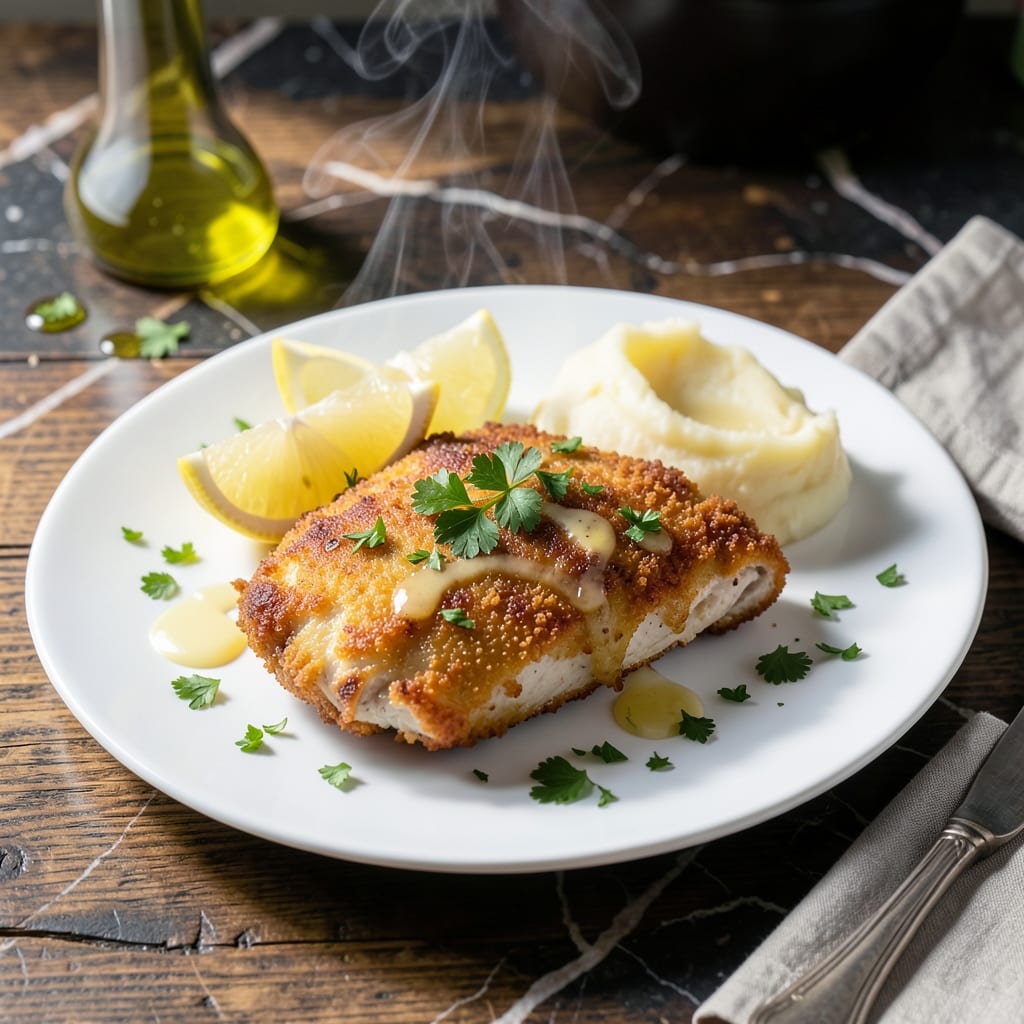
I developed this method after testing countless variations, determined to achieve authentic Austrian crispiness at home. The key lies in the three-step breading process and precise frying temperature.
Each cutlet emerges with a shatteringly crispy golden crust that gives way to tender chicken inside. I use fine breadcrumbs and pounded-thin cutlets for that signature delicate texture.
This technique transforms simple ingredients into restaurant-quality schnitzel. The secret is maintaining hot oil and working quickly to prevent the coating from absorbing excess grease.
Serve immediately with lemon wedges and a simple green salad for the complete Austrian experience. The contrast of textures makes every bite satisfying.
Ingredients for Austrian Chicken Recipe Schnitzel
Fine breadcrumbs and pounded-thin cutlets create that signature Austrian crispiness at home.
| Ingredient | Amount | Notes |
|---|---|---|
| Chicken Breast Cutlets 🍗 | 1 ½ lb | Pounded to 1/4-inch thickness |
| All-Purpose Flour 🌾 | 1 cup | For initial dredging |
| Large Eggs 🥚 | 2 whole | Beaten for egg wash |
| Fine Dry Breadcrumbs 🍞 | 2 cups | Panko is too coarse |
| Kosher Salt 🧂 | 1 tsp | Diamond Crystal preferred |
| Freshly Ground Black Pepper 🌶️ | ½ tsp | Coarsely ground |
| Neutral Oil for Frying 🫒 | 3 cups | Peanut or vegetable oil |
| Unsalted Butter 🧈 | 2 tbsp | Melted, for breadcrumbs |
| Lemon Wedges 🍋 | 1 whole | For serving |
| Fresh Parsley 🌿 | ¼ cup | Chopped, for garnish |
| Dijon Mustard 🟡 | 2 tbsp | Optional, for serving |
| Garlic Powder 🧄 | ½ tsp | Added to breadcrumbs |
The breadcrumbs must be fine—Panko won’t deliver the authentic texture. For chicken, thin-cut breast cutlets are ideal, but you can pound boneless, skinless breasts yourself. Whole Foods or Trader Joe’s often carry pre-cut options that save time. The oil temperature is critical: use a thermometer to maintain 350-375°F for perfect crispiness without greasiness.
No fine breadcrumbs? Pulse panko in a food processor for a similar texture. Gluten-free breadcrumbs work but may require pressing harder to adhere. For extra flavor, add one-third the amount of grated Parmesan to the breadcrumb mixture. If you’re avoiding dairy, skip the butter in the breadcrumbs—they’ll still crisp up nicely.
Serve immediately for peak texture. Leftovers keep in the fridge for 2-3 days but lose their crispness. Reheat in a 400°F oven for 10 minutes to revive. The breaded cutlets can be prepped ahead and refrigerated for 2 hours before frying.
Why You’ll Love This Recipe
- Weeknight Hero: It’s just flour, egg, breadcrumbs—no fancy steps, and I can have golden schnitzel on the table faster than takeout arrives.
- Crispy Perfection: That first bite with the shatter-crisp crust and juicy chicken inside? Honestly, it’s why I make this every other week.
- Crowd Pleaser: From picky kids to dinner guests, everyone cleans their plate. I’ll be real: even my veggie-averse nephew asks for seconds.
- Budget Winner: Chicken cutlets and pantry staples stretch far—leftovers reheat beautifully for next-day sandwiches, so nothing goes to waste.
Step-by-Step Instructions for Austrian Chicken Schnitzel
Master the technique for achieving paper-thin cutlets with an irresistibly crisp golden coating.
Step 1: Prepare the Breading Stations
Set up three shallow dishes for your breading assembly line. In the first, combine the 1 cup All-Purpose Flour with the 1 tsp Kosher Salt and 0.5 tsp Freshly Ground Black Pepper. This seasoned flour creates the base layer that helps the egg adhere.
In the second dish, beat the 2 whole Large Eggs until fully blended and frothy. For the third station, mix the 2 cups Fine Dry Breadcrumbs with the 0.5 tsp Garlic Powder and the 2 tbsp Unsalted Butter melted and cooled slightly. The butter enriches the crumbs for extra crispiness.
Step 2: Bread the Chicken Cutlets
Working with one cutlet at a time, dredge the 1.5 lb Chicken Breast Cutlets in the seasoned flour, shaking off any excess. The flour coating should be thin and even—press lightly to ensure full coverage.
Dip the floured cutlet into the beaten eggs, allowing any excess to drip off for 5 seconds. Then transfer to the breadcrumb mixture, pressing firmly to create an even, thick coating. Place the breaded cutlet on a wire rack and let it rest for 10 minutes to set the crumbs.
Step 3: Fry to Golden Perfection
Heat the 3 cups Neutral Oil for Frying in a large, deep skillet over medium-high heat until it reaches 350-360°F. To test, drop in a pinch of breadcrumbs—if it sizzles immediately and floats to the surface, the oil is ready.
Carefully place two cutlets in the hot oil, ensuring they don’t touch. Fry for 3-4 minutes per side until the coating is deep golden brown and crisp. The oil should bubble steadily but not violently. Use tongs to turn the cutlets, and avoid piercing the coating.
Step 4: Drain and Finish
Transfer the fried cutlets to a paper towel-lined plate to drain excess oil. The schnitzel should be crisp enough to hear a satisfying crunch when pressed lightly. Season immediately with a pinch of Kosher Salt while still hot to enhance the flavor.
Repeat with the remaining cutlets, maintaining the oil temperature between batches. If the oil starts to smoke, reduce the heat slightly. Keep the finished schnitzel warm in a 200°F oven while you fry the rest.
Step 5: Serve with Traditional Accompaniments
Arrange the schnitzel on a serving platter and garnish with the 0.25 cup Fresh Parsley chopped finely. Serve immediately with the 1 whole Lemon Wedges for a bright, acidic contrast that cuts through the richness.
For an authentic touch, offer the 2 tbsp Dijon Mustard on the side. The schnitzel should be served hot, with a coating so crisp it shatters at the first bite, revealing tender, juicy meat beneath.
Pro Tips For Making Austrian Chicken Recipe Schnitzel
- Pound the Cutlets: Use a meat mallet or rolling pin to pound the chicken breast cutlets to an even 1/4-inch thickness—this guarantees even cooking and that signature tender bite.
- Warm the Eggs: I learned this the hard way—cold eggs make the breading clump. Sit them in warm water for 5 minutes before dipping for a smoother, more even coat.
- Skip Thick Breadcrumbs: Fine dry breadcrumbs are non-negotiable here. Panko or fresh breadcrumbs give a chunky texture that just doesn’t match traditional Austrian schnitzel.
- Rest Before Frying: After breading, let the cutlets rest for 10 minutes on a wire rack—this keeps the coating from sliding off in the pan and actually changes the outcome.
Regional Styles of This Recipe
Viennese Classic
In Vienna, Wiener Schnitzel traditionally uses veal, but chicken works beautifully with the same technique. The key is pounding the meat to ⅛-inch thickness for that delicate, paper-thin texture that shatters when cut. I learned this from a Viennese chef friend who swore by using a meat mallet with a smooth face. 🗺️
Tyrolean Influence
The Tyrol region adds a touch of nutmeg to the breadcrumbs, which pairs wonderfully with the subtle flavor of chicken. I use just ¼ tsp for 2 cups breadcrumbs to avoid overpowering the dish. The mountains inspire hearty meals, so they often serve schnitzel with buttered potatoes.
Hungarian Adaptation
Just across the border, Hungarians make Rakott Csirke, a layered schnitzel casserole. For a simpler twist, I’ve topped chicken schnitzel with sour cream sauce and mushrooms. The tangy sauce complements the crispy coating beautifully.
Salzburg Style
In Salzburg, they sometimes use lard instead of oil for frying, which adds a richer flavor. I’ve found leaf lard from my neighborhood butcher works best. The result is a slightly more savory crust that’s still light and crisp.
Carinthian Touch
Southern Austria’s Carinthia region adds fresh herbs to the breading. I mix in 1 tbsp chopped dill or parsley for a fresh, aromatic note. This version feels lighter and is perfect for spring and summer meals. 💛
Modern Austrian
Contemporary Austrian chefs are experimenting with gluten-free breadcrumbs and almond flour for a lighter coating. I’ve tested this with 1 cup almond flour mixed with 1 cup gluten-free breadcrumbs—it’s surprisingly crisp and delicious.
Nutrition Facts
Frequently Asked Questions
Why pound the chicken so thin?
Thin cutlets ensure even cooking and that signature delicate, shatteringly crisp texture. Aim for 1/4-inch thickness maximum for authentic results. Thicker pieces won’t cook through properly before the coating burns.
Can I bake instead of fry?
Baking works but won’t achieve the same crispiness. Use 400°F with a wire rack for air circulation. brush with oil and bake for 15-20 minutes, flipping halfway. The texture will be different but still delicious.
How do I keep the coating from falling off?
Press the breadcrumbs firmly onto each cutlet and let them rest for 10 minutes before frying. Also, maintain oil at 350-360°F—too low and the coating absorbs oil, too high and it burns before adhering.
What oil is best for frying?
Use neutral oils like vegetable, peanut, or canola with a high smoke point. Avoid olive oil—it burns at the required 350-360°F. You’ll need about 3 cups for proper depth.

- BBQ Sausage Recipe Oven: Smoky Depth Without the Grill - September 28, 2026
- BBQ Chicken Bowl Recipe Rice: Smoky Sweetness Over Fluffy Grains - September 28, 2026
- Beef Cutlet Recipe Ideas: Crispy Breaded Patties With Bold Seasonings - September 28, 2026