
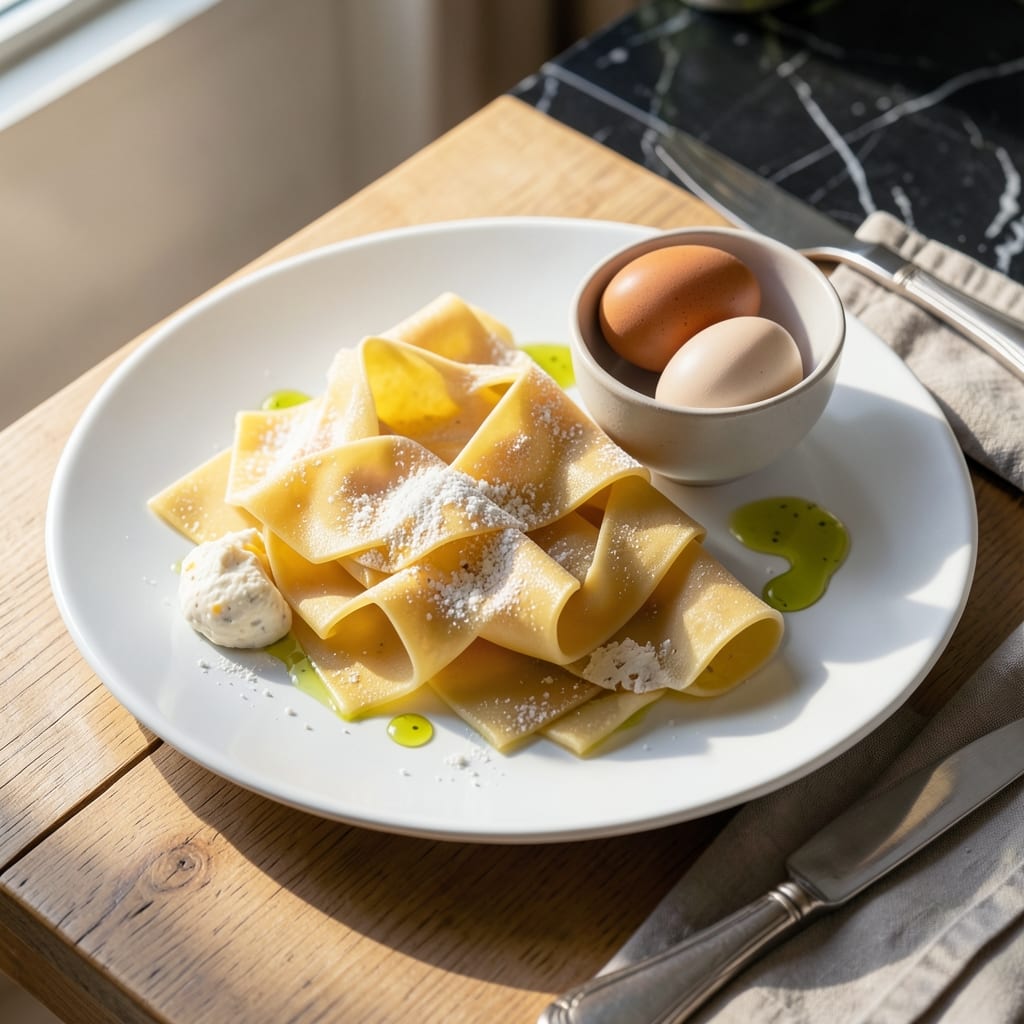
There’s nothing like the texture of fresh pasta made with 00 flour—silky, delicate, and far superior to dried. This proven technique transforms basic ingredients into restaurant-quality strands with minimal effort.
The process is simpler than you might expect. A precise ratio of flour to eggs, proper kneading, and adequate resting time create dough that rolls out smoothly. The key is patience during each stage.
You’ll be rewarded with pasta that cooks in 2-3 minutes and absorbs sauces beautifully. The difference from store-bought is immediately noticeable in both texture and flavor.
Once you master this method, you’ll never want to go back to boxed pasta. The results speak for themselves.
Ingredients for Fresh Pasta Recipe 00 Flour
Six ingredients. That’s all you need for pasta that puts store-bought to shame.
| Ingredient | Amount | Notes |
|---|---|---|
| 00 Flour 🌾 | 3 cups | Plus extra for dusting |
| Large Eggs 🥚 | 4 whole | Room temperature preferred |
| Extra-Virgin Olive Oil 🫒 | 1 tbsp | For elasticity in dough |
| Sea Salt 🧂 | ½ tsp | Fine grain for even distribution |
| Semolina Flour 🌾 | ½ cup | For dusting and texture |
| Water 💧 | 1 tbsp | Adjust as needed for humidity |
The 00 flour is non-negotiable—it’s what gives that ultra-smooth texture. Eataly or King Arthur carry it, but most well-stocked supermarkets have it too. Room temperature eggs incorporate better (just let them sit out for 30 minutes). I always use fine sea salt here—coarser grains don’t dissolve as well in the dough. Semolina for dusting adds a nice bite, but all-purpose works in a pinch.
No 00 flour? All-purpose flour at a 1:1 ratio works, but the texture won’t be quite as silky. Out of eggs? You’d need to rethink this one—eggs are essential for binding. Short on olive oil? Melted butter adds richness, but it’ll change the flavor slightly. The water is flexible—add it slowly, as humidity levels vary by kitchen and flour brand.
Fresh pasta cooks fast—2-3 minutes in boiling water—so have your sauce ready. Dough keeps in the fridge for 24 hours (wrapped tightly) or freezes for 1 month. Thaw in the fridge before rolling. Leftovers? Toss with a little oil and refrigerate for 3-4 days.
Why You’ll Love This Recipe
- No-Knead Magic: I just mix the 00 flour, eggs, and a drizzle of olive oil—no fancy equipment or tedious kneading required.
- Silky Texture: The 00 flour gives it that melt-in-your-mouth tenderness you only get from fresh pasta.
- Budget Luxury: Honestly, it costs pennies per serving but tastes like a high-end Italian restaurant dish.
Step-by-Step Instructions for Fresh Pasta
Here’s the method I use to create silky strands every time.
Step 1: Create the Dough on a Clean Surface
On a clean work surface, mound the 3 cups 00 Flour and make a well in the center. Crack the 4 whole Large Eggs into this well, then add the 1 tbsp Extra-Virgin Olive Oil and 0.5 tsp Sea Salt.
Using a fork, gradually incorporate the flour into the wet ingredients, working from the inner rim outward. Keep mixing until a shaggy dough forms. The texture should feel slightly sticky but not wet. This is where the magic starts—don’t rush it.
Step 2: Knead to Develop the Gluten
Once the dough comes together, start kneading with the heels of your hands. Push the dough away from you, then fold it back over itself and turn it 45 degrees. Repeat this motion for 8-10 minutes until the dough becomes smooth and elastic.
You’ll notice the dough transforms from rough and crumbly to silky and supple. If it feels too dry, add the 1 tbsp Water a few drops at a time. If it’s too sticky, dust lightly with some extra 00 flour. The dough is ready when it springs back when pressed lightly with a finger.
Step 3: Rest the Dough for Optimal Texture
Wrap the kneaded dough tightly in plastic wrap and let it rest at room temperature for 30 minutes. This rest allows the gluten to relax, making the dough much easier to roll out later.
During this time, the dough will also absorb any remaining moisture evenly, ensuring a uniform texture. Don’t skip this step—resting is what separates good pasta from great pasta. You’ll see the difference when you start rolling.
Step 4: Roll and Cut the Pasta Sheets
Divide the rested dough into 4 equal portions. Working with one portion at a time (keep the others covered), flatten it slightly with your hands. Set your pasta machine to its widest setting and feed the dough through.
Fold the sheet in thirds like a letter and repeat the rolling process 2-3 times at the widest setting. Then, gradually decrease the thickness setting, rolling the dough through once at each level until you reach the desired thinness. Dust with 0.5 cup Semolina Flour as needed to prevent sticking.
For strands, cut the rolled sheets into your preferred width using your pasta machine’s cutting attachment. Immediately toss the cut pasta with a bit more semolina flour to prevent clumping.
Step 5: Cook the Fresh Pasta
Bring a large pot of salted water to a rolling boil. Add the fresh pasta and cook for 2-3 minutes until it floats to the surface. Fresh pasta cooks much faster than dried, so watch it closely.
You’ll know it’s done when the strands are tender but still have a slight bite. Drain immediately and toss with your favorite sauce. The texture will be noticeably more delicate than store-bought pasta, with a perfect balance of tenderness and chew.
Pro Tips For Making Fresh Pasta Recipe 00 Flour
- Knead Longer: I learned this the hard way—under-kneading gives you tough pasta. Work that 00 flour and egg dough for at least 8-10 minutes until it’s smooth as silk.
- Use Room-Temp Eggs: Sounds weird, but it works: cold eggs make the dough seize up. Pull your large eggs out of the fridge 30 minutes before mixing for easier incorporation.
- Skip the Over-Flouring: Resist the urge to dump in extra 00 flour when rolling—just dust with semolina. Too much flour makes your pasta dry and brittle, not tender.
- Rest the Dough: After burning three batches, I finally figured out that letting the dough rest for 30 minutes under a towel relaxes the gluten for easier rolling and cutting.
Best Sauces and Condiments for This fresh pasta recipe 00 flour
Classic Carbonara
The delicate texture of this pasta begs for a creamy carbonara. Toss hot strands with 2 beaten eggs, ½ cup grated Pecorino Romano, and 4 oz crispy pancetta. The residual heat will create a silky sauce without scrambling the eggs. 💛
Simple Cacio e Pepe
Sometimes less is more. For cacio e pepe, toast 1 tsp black peppercorns in butter, then toss with pasta, 1 cup reserved pasta water, and 1½ cups grated Pecorino Romano. Stir vigorously until creamy.
Herb Butter Sauce
Melt 6 tbsp unsalted butter with 2 tbsp fresh parsley, 1 minced garlic clove, and a pinch of sea salt. Drizzle over pasta and toss with ¼ cup grated Parmesan. The simplicity lets the pasta shine.
Tomato Basil Sauce
For a fresh option, blend 2 cups San Marzano tomatoes with 5 fresh basil leaves and 1 tbsp olive oil. Simmer for 10 minutes, then toss with pasta. Finish with fresh basil and shaved Parmigiano-Reggiano. 🌟
Pesto Perfection
Blend 2 cups fresh basil, ¼ cup pine nuts, ½ cup olive oil, ½ cup grated Parmesan, and 1 garlic clove until smooth. Toss with pasta and add ¼ cup reserved pasta water to loosen the sauce.
Garlic and Oil
Heat ½ cup olive oil with 4 minced garlic cloves and ½ tsp red pepper flakes until fragrant. Pour over pasta and toss with ¼ cup chopped parsley. A classic that highlights the pasta’s texture.
Nutrition Facts
Frequently Asked Questions
Why use 00 flour for pasta?
It creates an ultra-smooth texture because of its fine grind and low protein content. 00 flour absorbs moisture beautifully, resulting in tender yet sturdy strands. All-purpose works, but the texture won’t be as delicate.
Can I make pasta without a machine?
Roll the dough by hand with a rolling pin until paper-thin, then cut into strips. It takes more effort and may not be as uniform, but the taste is just as good. Dust with semolina flour to prevent sticking.
How do I know when the dough is ready?
It should feel smooth, elastic, and spring back when pressed. If it’s crumbly, add 1-2 tsp water. If too sticky, add 1-2 tbsp flour. Kneading for 8-10 minutes develops the gluten properly.
What if my pasta sticks together after cutting?
Toss fresh strands with semolina flour immediately after cutting. Cook in plenty of boiling water and stir gently at first to separate. Avoid overcrowding the pot.

- BBQ Sausage Recipe Oven: Smoky Depth Without the Grill - September 28, 2026
- BBQ Chicken Bowl Recipe Rice: Smoky Sweetness Over Fluffy Grains - September 28, 2026
- Beef Cutlet Recipe Ideas: Crispy Breaded Patties With Bold Seasonings - September 28, 2026