
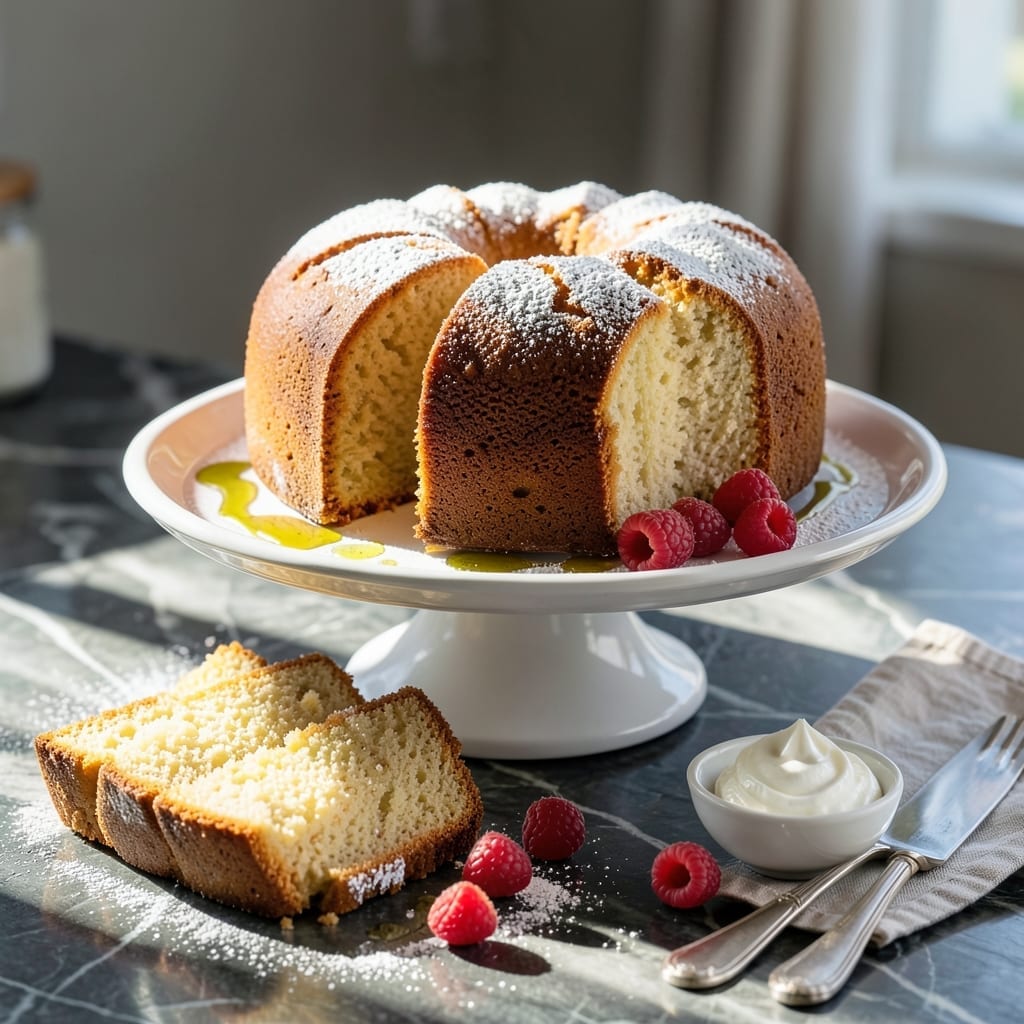
There’s a reason classic pound cake has stood the test of time—its ultra fine crumb and buttery depth make it a dessert worth mastering. This version relies on cake flour for a texture that’s impossibly tender yet sturdy enough to hold up to any topping.
The key to achieving that signature tight crumb lies in proper creaming of butter and sugar, followed by careful incorporation of eggs and dry ingredients. Cake flour’s lower protein content creates a more delicate structure than all-purpose flour, resulting in a cake that’s both light and rich.
What emerges from the oven is a golden pound cake with a velvety texture and pure buttery flavor. The exterior forms a thin, slightly crisp crust that gives way to a moist, dense interior that practically melts in your mouth.
Serve it plain, dusted with powdered sugar, or topped with fresh berries and whipped cream. This recipe delivers consistent results every time.
Ingredients for Pound Cake Recipe with Cake Flour
Classic ingredients for a timeless pound cake with ultra fine texture and rich buttery flavor.
| Ingredient | Amount | Notes |
|---|---|---|
| Unsalted Butter 🧈 | 1 cup | Room temperature, for creaming |
| Granulated Sugar 🍚 | 1 ½ cups | Fine grain for even distribution |
| Large Eggs 🥚 | 5 whole | Room temperature for best volume |
| Cake Flour 🌾 | 2 ½ cups | Sifted for ultra fine crumb |
| Baking Powder 🧂 | 1 tsp | Fresh for optimal rise |
| Salt 🧂 | ½ tsp | Fine sea salt preferred |
| Vanilla Extract 🌿 | 2 tsp | Pure extract for best flavor |
| Heavy Cream 🥛 | ½ cup | Full-fat for richness |
| Powdered Sugar 🍚 | ¼ cup | For dusting, optional |
| Fresh Berries 🍓 | 1 cup | For serving, optional |
| Whipped Cream 🍦 | ½ cup | Freshly whipped, optional |
The butter and cake flour are non-negotiable here. Plugrá or European-style butter (82% fat) gives superior depth, but any unsalted will work. Swans or Softasilk are top cake flour brands—look for them in the baking aisle. Room temperature ingredients cream together better, so pull eggs and butter out 1-2 hours before baking. Don’t rush this step (it makes all the difference in texture).
No cake flour? Measure 2.5 cups all-purpose flour, remove 5 tbsp, replace with 5 tbsp cornstarch. This DIY version mimics the lower protein content. Heavy cream not on hand? Whole milk or half-and-half works too, though the crumb may be slightly less tender. Vanilla extract can be swapped for vanilla bean paste (use 1 tbsp per 2 tsp extract).
Store the cooled cake wrapped in plastic at room temperature for 4-5 days. For longer storage, freeze slices for up to 3 months. The flavor actually deepens after a day, making it perfect for prep ahead. Dust with powdered sugar just before serving (so it stays crisp).
Why You’ll Love This Recipe
- I’ll be real: this stays moist for days, so leftovers taste just as good as the first slice.
- One Bowl Wonder: I just cream the butter and sugar, add the eggs, then fold in the cake flour—no fuss, no extra dishes.
- Buttery Richness: The unsalted butter and cake flour make it tender with that classic, melt-in-your-mouth feel.
- Feeds a Crowd: Honestly, it’s my go-to for potlucks, birthdays, or just because Tuesday needs a little sweetness.
Step-by-Step Instructions for Pound Cake With Cake Flour
This method ensures a tender crumb and rich buttery flavor with every slice.
Step 1: Cream Butter and Granulated Sugar
In a stand mixer with the paddle attachment, beat the 1 cup Unsalted Butter and 1.5 cups Granulated Sugar on medium speed for 4-5 minutes. The mixture should become light, fluffy, and nearly double in volume, turning a pale yellow color.
This creaming process incorporates air, which creates the fine, tender crumb characteristic of pound cake. Scrape down the sides of the bowl halfway through to ensure even mixing. The butter should be at room temperature—if it’s too cold, it won’t cream properly.
Step 2: Incorporate Eggs and Vanilla Extract
Add the 5 whole Large Eggs one at a time, mixing well after each addition for 30 seconds. This gradual incorporation prevents the mixture from curdling and ensures a smooth batter. After the last egg is fully incorporated, add the 2 tsp Vanilla Extract and mix for another 10 seconds.
Room temperature eggs are essential here—they whip up better and create a more stable emulsion. If the mixture looks slightly separated after adding the eggs, don’t worry. It will come together once the dry ingredients are added.
Step 3: Combine Dry Ingredients and Heavy Cream
In a separate bowl, whisk together the 2.5 cups Cake Flour, 1 tsp Baking Powder, and 0.5 tsp Salt. With the mixer on low speed, add the dry ingredients to the wet mixture in three additions, alternating with the 0.5 cup Heavy Cream in two additions.
Begin and end with the dry ingredients, mixing just until each addition is incorporated. Overmixing develops gluten, which can make the cake dense. The batter will be thick and smooth, with no visible streaks of flour.
Step 4: Bake to Golden Perfection
Pour the batter into a greased and floured 9×5-inch loaf pan. Smooth the top with a spatula. Bake in a preheated 325°F oven for 1 hour to 1 hour 15 minutes, or until a toothpick inserted into the center comes out clean or with a few moist crumbs.
The cake is done when the top is golden brown and springs back lightly when touched. If the top begins to brown too quickly, loosely tent the pan with foil. Avoid opening the oven door during the first 45 minutes to prevent the cake from sinking.
Step 5: Cool and Serve
Allow the cake to cool in the pan for 15 minutes, then transfer it to a wire rack to cool completely. This cooling period helps the cake set and makes it easier to slice cleanly without crumbling.
Once cooled, dust with 0.25 cup Powdered Sugar if desired. Serve slices with 1 cup Fresh Berries and 0.5 cup Whipped Cream for a simple yet elegant presentation. The cake keeps well at room temperature for up to 3 days if wrapped tightly.
Pro Tips For Making Pound Cake Recipe With Cake Flour
- Room Temp Butter: Take your unsalted butter out 1-2 hours before baking—it should dent when pressed, not melt into a greasy puddle. I learned this the hard way after my first cake turned out dense and flat.
- Sift the Flour: Cake flour is fine but still needs sifting, especially with baking powder mixed in. My grandmother swore by this, and her cakes were always light as air.
- Cream Long Enough: Beat the butter and sugar for a full 5-7 minutes until pale and fluffy—sounds tedious, but it actually changes the outcome. After burning three batches, I finally figured out this was the missing step.
- Don’t Overmix: Fold in the cake flour just until the streaks disappear—overworking it develops gluten and turns your cake tough. I was skeptical until I tried it, but the texture difference is undeniable.
Essential Equipment for pound cake recipe with cake flour
Stand Mixer
A quality stand mixer is non-negotiable for this recipe. I use my KitchenAid 5-Quart with the paddle attachment to cream butter and sugar perfectly. The motor handles the thick batter without straining, and the capacity fits all ingredients comfortably.
Loaf Pan
Invest in a 9×5-inch loaf pan with a non-stick coating. My favorite is the USA Pan with its reinforced steel construction. Proper size ensures even baking and the classic pound cake shape. Always grease and flour it thoroughly, even if non-stick.
Digital Scale
For precise measurements, I rely on my OXO Good Grips 11lb scale. Cake flour compacts easily, so weighing 280g (for 2.5 cups) guarantees accuracy. This small step makes a noticeable difference in texture. 💡
Cooling Rack
A wire cooling rack allows air circulation underneath the cake, preventing sogginess. I use a simple stainless steel rack that fits over my sink. Let the cake cool for 15 minutes in the pan before transferring to prevent breaking.
Rubber Spatula
A good silicone spatula helps scrape every bit of batter from the bowl. I prefer the GIR brand for its heat resistance and comfortable grip. Use it to smooth the top of the batter in the pan for even baking.
Toothpick Tester
For checking doneness, I keep a supply of wooden toothpicks on hand. Insert one into the center—the cake is done when it comes out clean or with a few moist crumbs. This simple tool prevents overbaking. 🔥
Nutrition Facts
Frequently Asked Questions
Why use cake flour instead of all-purpose?
Cake flour has lower protein content, creating a finer, more delicate crumb. It results in a lighter texture compared to all-purpose flour.
Can I make this without a stand mixer?
Yes, use a hand mixer on medium speed. Cream butter and sugar for 5-7 minutes to achieve proper aeration. A whisk won’t incorporate enough air.
How do I prevent my cake from sinking in the middle?
Avoid opening the oven during the first 45 minutes. Ensure all ingredients are at room temperature and don’t overmix the batter.
What’s the best way to store leftover cake?
Wrap tightly in plastic at room temperature for 4-5 days. For longer storage, freeze slices for up to 3 months.

- Protein Pudding Recipe With Sugar Free Pudding: High-Protein Creamy Indulgence - November 3, 2026
- Progresso Recipe Starters Creamy Parmesan Basil Cooking Sauce: Rich Herb-Infused Base for Pasta and More - November 3, 2026
- Pudding Recipe With Egg Yolks: Silky Smooth Custard in Minutes - November 3, 2026