
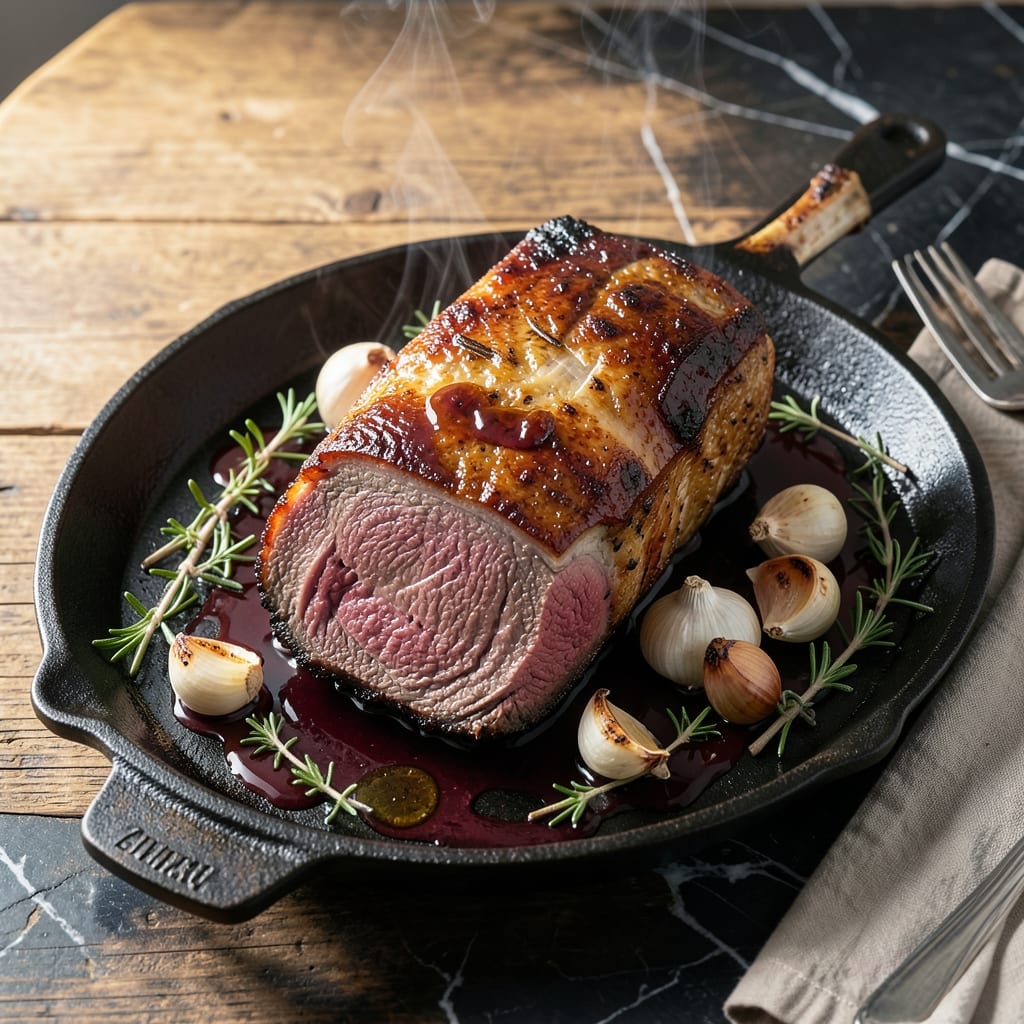
Few dishes command respect like a perfectly cooked prime rib, and this method delivers medium-rare perfection every time. The low-and-slow approach in your oven transforms tough cuts into tender, juicy slices with a caramelized crust.
I developed this technique after years of holiday cooking, learning that patience and precision matter more than fancy equipment. A simple dry rub and proper resting time ensure the meat retains its natural juices and rich flavor.
The result is a showstopping centerpiece with a deep brown exterior and pink, succulent center. Every bite offers the buttery richness that makes prime rib a special-occasion staple.
Serve with au jus and horseradish cream for the full experience. This is how to master the art of prime rib at home.
Ingredients for Prime Rib Roast Beef Recipe Oven
A select bone-in roast and bold aromatics transform this into a holiday-worthy centerpiece.
| Ingredient | Amount | Notes |
|---|---|---|
| Bone-In Prime Rib Roast 🥩 | 5 lb | First cut preferred, well-marbled |
| Kosher Salt 🧂 | 2 tbsp | Diamond Crystal preferred |
| Freshly Ground Black Pepper 🌶️ | 2 tsp | Coarse grind recommended |
| Garlic Cloves 🧄 | 6 cloves | Peeled and smashed |
| Fresh Rosemary Sprigs 🌿 | 4 sprigs | Stems removed, finely chopped |
| Fresh Thyme Sprigs 🍃 | 4 sprigs | Leaves stripped, stems discarded |
| Dijon Mustard 🟡 | 2 tbsp | Whole grain preferred |
| Olive Oil 🫒 | 2 tbsp | Extra-virgin for richness |
| Red Wine 🍷 | 1 cup | Dry, full-bodied variety |
| Beef Stock 🥘 | 2 cups | Low-sodium preferred |
| Unsalted Butter 🧈 | 4 tbsp | For basting and au jus |
| All-Purpose Flour 🌾 | 2 tbsp | For thickening au jus |
| Prepared Horseradish 🥬 | ½ cup | For horseradish cream |
| Sour Cream 🥛 | ½ cup | Full-fat for best texture |
| Worcestershire Sauce 🍶 | 1 tbsp | Anchovy-free if preferred |
The prime rib itself is non-negotiable. First-cut roasts (ribs 10-12) offer the best fat marbling and tenderness. Source from a reputable butcher—Costco and Whole Foods carry excellent pre-trimmed options. Look for bright red color with abundant white fat streaks. Dry aging at home? Unwrap the roast and leave it uncovered in the fridge for 24-48 hours before cooking.
No fresh herbs? Dried at one-third the amount works, but fresh delivers superior aromatic complexity. Substitute sherry or port for red wine—both add depth to the au jus. For horseradish cream, Greek yogurt can replace sour cream at a 1:1 ratio. The Dijon mustard can be swapped with whole-grain mustard for a rustic texture.
Prime rib needs a long rest—30-45 minutes at room temperature before slicing to redistribute juices. Store leftovers wrapped tightly for up to 4 days in the fridge, or freeze for 3 months (slice before freezing for easier reheating).
Why You’ll Love This Recipe
- Hands-Off Cooking: I just season it, pop it in the oven, and let the dry heat work its magic—no babysitting required.
- Garlic-Rosemary Perfection: The garlic and rosemary create a crust so flavorful, I’ve caught my family sneaking bites straight from the pan.
- Holiday Hero: This is my showstopper for Christmas and birthdays, but honestly, I’ve made it just because it’s Tuesday and we deserve it.
- Next-Day Magic: The leftovers make the best sandwiches I’ve ever had—thinly sliced with a little horseradish on crusty bread.
Step-by-Step Instructions for Prime Rib Roast Beef
Master the reverse sear method for evenly cooked, medium-rare prime rib with a flavorful crust.
Step 1: Prepare and Season the Roast
Remove the 5 lb Bone-In Prime Rib Roast from the refrigerator 2 hours before cooking to bring it to room temperature. This ensures even cooking throughout the thick cut. Pat it completely dry with paper towels—moisture prevents proper browning.
In a small bowl, combine the 2 tbsp Kosher Salt, 2 tsp Freshly Ground Black Pepper, 6 cloves Garlic Cloves (peeled and smashed), 4 sprigs Fresh Rosemary Sprigs (finely chopped), and 4 sprigs Fresh Thyme Sprigs (leaves stripped). Rub this mixture all over the roast, pressing it into the meat so it adheres. Drizzle with the 2 tbsp Olive Oil, then spread the 2 tbsp Dijon Mustard evenly over the surface to create a flavorful base for the crust.
Step 2: Slow-Roast at Low Temperature
Preheat your oven to 250°F. Place the roast bone-side down on a rack in a roasting pan (the bones act as a natural rack). Insert a meat thermometer into the thickest part of the roast, avoiding the bone.
Roast uncovered for approximately 2.5 to 3 hours, or until the internal temperature reaches 120°F for medium-rare. The low heat ensures gentle, even cooking without drying out the exterior. Baste the roast with its juices halfway through cooking to enhance flavor and moisture.
Step 3: Sear for a Perfect Crust
Remove the roast from the oven and increase the temperature to 450°F. Once the oven is fully preheated, return the roast to the oven for 15-20 minutes to develop a deep, golden-brown crust. Watch closely to avoid over-browning.
Transfer the roast to a cutting board and tent loosely with foil. Let it rest for 20-30 minutes before carving—this allows the juices to redistribute, ensuring every slice is moist and flavorful. The internal temperature will rise to about 130°F during this time, perfect for medium-rare.
Step 4: Prepare the Au Jus and Horseradish Cream
While the roast rests, place the roasting pan on the stovetop over medium heat. Add the 1 cup Red Wine and 2 cups Beef Stock, scraping up any browned bits. Bring to a simmer and cook for 5 minutes.
In a small bowl, whisk the 2 tbsp All-Purpose Flour with 4 tbsp Unsalted Butter to form a paste. Whisk this into the pan juices and simmer for 3-5 minutes until thickened. For the horseradish cream, combine the 0.5 cup Prepared Horseradish, 0.5 cup Sour Cream, and 1 tbsp Worcestershire Sauce in a bowl. Serve both alongside the carved roast.
Pro Tips For Making Prime Rib Roast Beef Recipe Oven
- Dry the Roast: Pat the prime rib completely dry with paper towels before seasoning—any moisture left on the surface will steam the meat instead of searing it.
- Salt Overnight: I learned this the hard way—salt the roast at least 12 hours ahead and leave it uncovered in the fridge for a perfectly seasoned crust.
- Skip the Water Pan: Resist the urge to add water to the roasting pan; the prime rib will steam instead of roast, giving you a soft crust instead of a crisp one.
- Rest Before Carving: After pulling it from the oven, tent the roast with foil and give it a solid 20-30 minutes to rest—this keeps the juices where they belong, in the meat.
Wine and Beer Pairings for prime rib roast beef recipe oven
Bold Red Wines
For this rich dish, I reach for a Cabernet Sauvignon from Napa Valley—its bold tannins and dark fruit notes cut through the fat beautifully. A 2018 Chateau Montelena is my splurge choice, but Josh Cellars offers great value at $15-20. 🍷
Classic Bordeaux
A Left Bank Bordeaux with its structured tannins and earthy notes complements prime rib perfectly. Look for Château Lynch-Bages or Château Pichon Longueville from the 2016 vintage. These pair with the au jus like they were made for each other.
Portland Craft Beers
Locally, I love pairing this with Deschutes Black Butte Porter—its chocolate and coffee notes stand up to the beef. For something lighter, Breakside Brewery’s IPA has the bitterness to cut through the richness. 🍺
Malbec Alternative
An Argentine Malbec like Catena Zapata offers juicy plum flavors with soft tannins. It’s more approachable than Cabernet but still holds its own. I find it especially good with the horseradish cream.
Stout Pairing
For beer lovers, a Russian Imperial Stout like The Abyss from Deschutes works surprisingly well. The roasted malt and dark fruit notes mirror the caramelized crust. Just 8 oz is plenty with a serving. 💫
Nutrition Facts
Frequently Asked Questions
What’s the ideal internal temperature for medium-rare?
Remove from oven at 120°F—it will rise to 130°F during resting. This ensures juicy, pink center slices every time.
Do I need to cover it while roasting?
No, leave it uncovered for the entire 2.5-3 hour slow-roast. This allows the crust to form properly and moisture to escape.
Can I use a boneless roast instead?
Yes, but reduce cooking time by 15-20%. Bones act as insulation, so boneless cooks faster. Always use a meat thermometer.
Why does it need to rest so long?
The 20-30 minute rest lets juices redistribute. Slicing too soon causes dry meat—patience is key for perfection.

- Progresso Recipe Starters Creamy Parmesan Basil Cooking Sauce: Rich Herb-Infused Base for Pasta and More - November 3, 2026
- Pudding Recipe With Egg Yolks: Silky Smooth Custard in Minutes - November 3, 2026
- Pudding Pops Recipe Cook and Serve: Silky Frozen Treats Without the Machine - November 3, 2026