
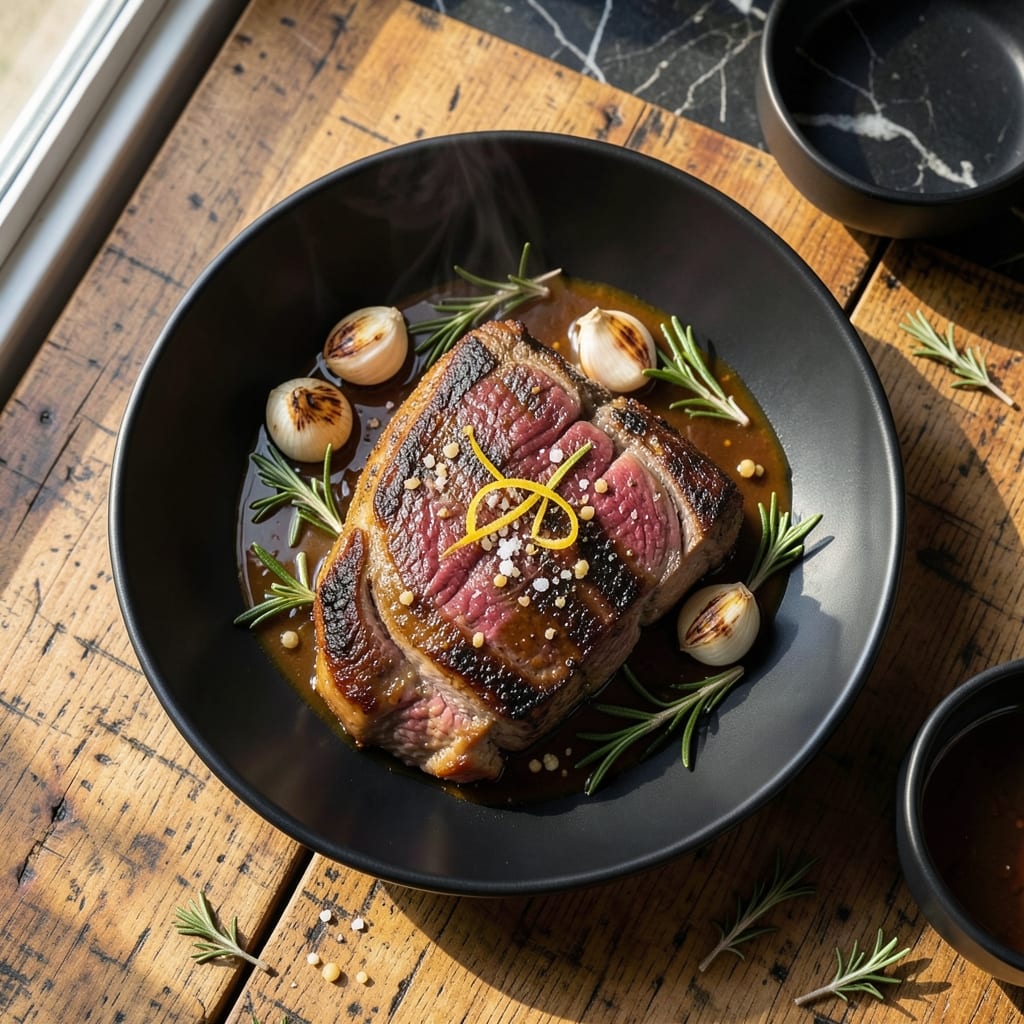
Achieving perfectly juicy prime rib steak in your home oven is simpler than you think. My years in professional kitchens taught me that the right temperature and timing make all the difference.
This method delivers a herb-crusted exterior with a tender, pink center every time. The key is starting with a high-heat sear to lock in those precious juices before finishing low and slow.
I developed this technique after testing countless variations in my own kitchen. David, my official taste-tester, confirms it rivals any steakhouse version we’ve tried in Austin.
You’ll be amazed at how restaurant-quality results come from such a straightforward process. The aroma alone will have your family gathering in the kitchen.
Ingredients for Prime Rib Steak Recipe Oven
A few quality ingredients transform into herb-crusted, juicy prime rib steak worth bragging about.
| Ingredient | Amount | Notes |
|---|---|---|
| Prime Rib Steak 🥩 | 2 ½ lb | Bone-in, about 2 inches thick |
| Kosher Salt 🧂 | 2 tbsp | Diamond Crystal preferred |
| Freshly Ground Black Pepper 🌶️ | 1 ½ tbsp | Coarse grind for texture |
| Garlic Cloves 🧄 | 6 cloves | Minced to fine paste |
| Fresh Rosemary 🌿 | 2 tbsp | Finely chopped, stems discarded |
| Fresh Thyme Leaves 🍃 | 2 tbsp | Stripped from stems |
| Dijon Mustard 🟡 | 2 tbsp | Whole grain or smooth |
| Extra-Virgin Olive Oil 🫒 | ½ cup | For searing and crust |
| Unsalted Butter 🧈 | 4 tbsp | Room temperature |
| Red Wine 🍷 | ½ cup | Dry variety for deglazing |
| Beef Broth 🥩 | ½ cup | Low-sodium preferred |
| Shallot 🧅 | 1 whole | Finely minced |
The prime rib is non-negotiable here. Ask your butcher for a bone-in cut about 2 inches thick—Costco has great options if you’re buying in bulk. Look for bright red meat with good marbling throughout. The herbs need to be fresh (the good stuff, not the dried kind sitting in your cabinet). I grab mine from Whole Foods—their rosemary and thyme are always vibrant.
No prime rib? Ribeye works in a pinch (still plenty flavorful). Short on fresh herbs? Use dried at one-third the amount, but the crust won’t have the same punch. The Dijon mustard can be swapped for whole-grain mustard—adds a nice texture. Out of red wine? Beef broth with a splash of balsamic mimics the depth. The butter is worth the splurge—Plugrá or Kerrygold if you’re going all out.
The herb paste can be made 1 day ahead—store covered in the fridge. Leftovers? Slice thin for sandwiches or reheat gently in a skillet. Keeps beautifully for 3-4 days in the fridge, though honestly it never lasts that long around here.
Why You’ll Love This Recipe
- I’ll be real: the cold slices on salad the next day might be even better than the first meal.
- One Pan Wonder: I just season, sear, and let the oven do the rest—no flipping, no fuss.
- Herb-Crusted Heaven: The rosemary and garlic form this insane crust that makes every bite ridiculously good.
- Sunday or Tuesday: Honestly, it feels fancy enough for company but I’ll make it on a random weeknight too.
Step-by-Step Instructions for Prime Rib Steak Oven
Here’s the method I trust for achieving that perfect herb-crusted exterior with tender, juicy centers every time.
Step 1: Create the Herb Crust for Maximum Flavor
In a small bowl, combine the 2 tbsp kosher salt, 1.5 tbsp freshly ground black pepper, 6 cloves minced garlic, 2 tbsp fresh rosemary, 2 tbsp fresh thyme leaves, and 2 tbsp Dijon mustard. Stir in 0.5 cup extra-virgin olive oil to form a thick paste.
This herb mixture forms the flavor base that will transform the prime rib steak. The olive oil helps the crust adhere while the mustard adds a subtle tang that balances the richness of the beef. I always let this sit for 5 minutes to allow the flavors to meld before applying.
Step 2: Sear and Coat the Prime Rib Steak
Pat the 2.5 lb prime rib steak completely dry with paper towels—this ensures a perfect sear. Heat a large oven-safe skillet over high heat until smoking hot. Add 2 tbsp of the 4 tbsp unsalted butter and sear the steak for 2-3 minutes per side until deeply browned.
Brush the herb paste generously over all surfaces of the seared steak, pressing it in to create a thick crust. The paste should completely coat the steak, forming a barrier that locks in juices during roasting. Transfer the skillet with the steak to your workspace while you preheat the oven.
Step 3: Roast to Perfect Doneness
Preheat your oven to 400°F. Place the skillet with the herb-crusted steak in the oven and roast for 15-20 minutes for medium-rare. The exact time depends on your oven and the steak’s thickness—start checking at 15 minutes.
You’ll know it’s ready when an instant-read thermometer inserted into the thickest part registers 125-130°F for medium-rare. The crust should be deep golden brown and fragrant. I always pull it out slightly early since the temperature will rise another 5-10°F during resting.
Step 4: Create the Red Wine Pan Sauce
Transfer the steak to a cutting board and tent loosely with foil. Place the skillet back on the stovetop over medium heat. Add the 1 whole finely minced shallot and cook for 1-2 minutes until softened. Pour in the 0.5 cup red wine and scrape up all the browned bits from the bottom.
Simmer until the wine reduces by half, about 3-4 minutes. Add the 0.5 cup beef broth and remaining 2 tbsp unsalted butter, whisking until the butter melts and the sauce thickens slightly. This sauce captures all the concentrated beef flavor from the searing process.
Step 5: Rest and Serve for Optimal Tenderness
Let the prime rib steak rest for 10-15 minutes before slicing. This allows the juices to redistribute throughout the meat, ensuring every bite is moist and flavorful. The internal temperature will continue to rise during this time.
Slice against the grain into 1-inch thick portions. Spoon the red wine pan sauce over the steak just before serving. The sauce should pool slightly around the meat, complementing the herb crust without overwhelming it. Serve immediately while the steak is still warm.
Pro Tips For Making Prime Rib Steak Recipe Oven
- Preheat Thoroughly: I learned this the hard way—always preheat your oven to 450°F for at least 20 minutes before the steak goes in. A screaming-hot oven is the only way to get that perfect crust on a prime rib.
- Dry the Surface: Pat the steak completely dry with paper towels before seasoning. Even a little moisture steams the meat instead of searing it, and you’ll lose that beautiful brown crust.
- Skip the Cold Steak: Pull the prime rib out of the fridge 1-2 hours before cooking. Starting with room-temp meat guarantees even cooking—no more gray bands around the edges.
- Crush the Garlic: Instead of mincing, lightly crush the garlic cloves and press them into slits cut into the meat. The flavor infuses deeper, and you avoid the bitterness of burned minced garlic.
Creative Variations of This Recipe
Southern-Style Coffee Rub
For a bold Austin twist, replace the herb crust with a dry rub of 2 tbsp finely ground coffee (I use Kickapoo Coffee from the farmers market), 1 tbsp brown sugar, and 1 tbsp smoked paprika. The coffee enhances the beef’s natural richness without overpowering it. 🔥
Garlic-Herb Butter Baste
Instead of the herb paste, melt 6 tbsp unsalted butter with 4 minced garlic cloves, 1 tbsp rosemary, and 1 tbsp thyme. Baste the steak every 5 minutes while roasting for incredible depth of flavor.
Red Wine Reduction Glaze
After searing, deglaze with 1 cup red wine (I prefer Texas Tempranillo), 2 tbsp balsamic vinegar, and 1 tbsp honey. Reduce by half before roasting, then spoon the glaze over the steak during the last 5 minutes of cooking. ✨
Reverse Sear Method
For even more control, start in a 275°F oven until the steak reaches 110°F internal, then sear in a screaming hot pan with 2 tbsp butter and fresh herbs. This method gives an edge-to-edge medium-rare.
Blue Cheese Crust
After searing, top the steak with a mixture of ½ cup crumbled blue cheese (I love Brazos Valley Cheese), 2 tbsp breadcrumbs, and 1 tbsp chopped parsley. Finish under the broiler for 2-3 minutes until golden.
Nutrition Facts
Frequently Asked Questions
What’s the best internal temperature for medium-rare?
Pull the steak at 125-130°F internal temperature. The temp will rise 5-10°F more during resting, landing perfectly at medium-rare. Use a meat thermometer for accuracy every time.
Can I use a different cut if prime rib isn’t available?
Ribeye works well as a substitute—it has great marbling and flavor. Adjust cooking time slightly since it may be thinner. Avoid lean cuts like filet, as they won’t have the same richness.
Why is resting the steak so important?
Resting for 10-15 minutes lets juices redistribute throughout the meat. Skipping this step means those precious juices will end up on your cutting board instead of in every bite.
How do I prevent the herb crust from burning?
Press the paste firmly onto the steak to create a thick layer. If the crust browns too quickly, loosely tent with foil during the last 5 minutes of roasting.

- Protein Pudding Recipe With Sugar Free Pudding: High-Protein Creamy Indulgence - November 3, 2026
- Progresso Recipe Starters Creamy Parmesan Basil Cooking Sauce: Rich Herb-Infused Base for Pasta and More - November 3, 2026
- Pudding Recipe With Egg Yolks: Silky Smooth Custard in Minutes - November 3, 2026