
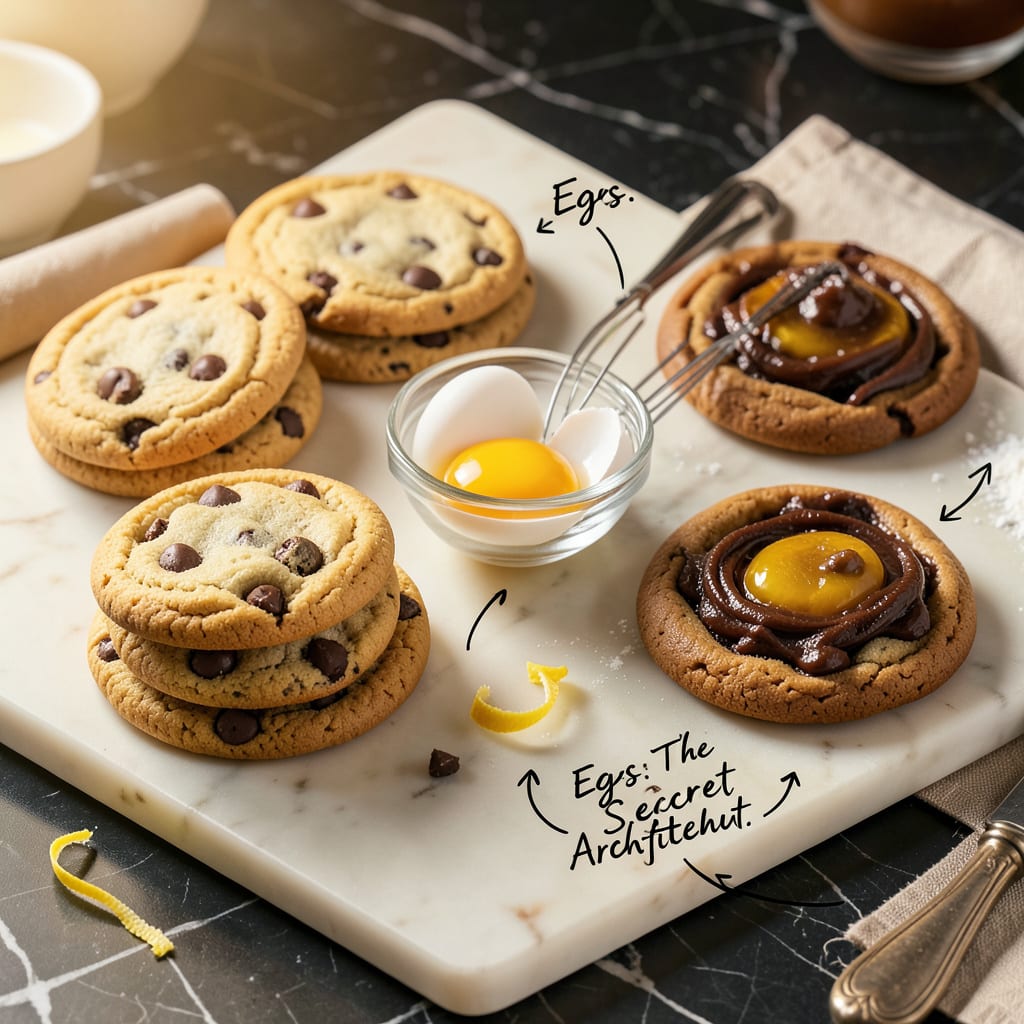
Eggs in cookies act as a binder to hold ingredients together, add moisture for a tender texture, help leaven for slight rise, and contribute richness through fat in the yolks. They also aid in browning and flavor development during baking.
I think of eggs as the multitasking powerhouse in cookie recipes. The proteins in egg whites coagulate during baking, creating a structural network that prevents crumbly textures. Meanwhile, the yolks introduce emulsifiers that help fats and liquids blend smoothly, ensuring even consistency throughout the dough. 🔥
What’s fascinating is how eggs influence both chemistry and sensory experience. They contribute to that perfect golden-brown color through Maillard reactions, while their moisture content prevents cookies from becoming dry or overly dense. This balance makes them indispensable for achieving bakery-quality results at home.
💡 In This Article
- The Science Behind Egg Functions in Cookie Baking
- Practical Egg Substitutes and Adjustments in Cookie Recipes
The Science Behind Egg Functions in Cookie Baking
When you crack an egg into cookie dough, you’re introducing a complex system of proteins that transform dramatically under heat. The proteins in egg whites begin coagulating at 144°F, creating a three-dimensional network that traps air and sets the cookie’s structure.
This process is similar to how eggs firm up when you scramble them, but in cookies it happens more gradually as the temperature rises in the oven. 🔥
The yolks contain lecithin, a natural emulsifier that acts like a bridge between fat and water molecules. This allows butter and sugar to distribute evenly throughout the dough rather than separating. Without this emulsification, you’d end up with pockets of grease and dry spots.
The fat in yolks also contributes to tenderness—about 4.5g per large yolk—which creates that melt-in-your-mouth quality we love in cookies.
Eggs contribute to leavening through two mechanisms: steam production and air incorporation. Each large egg adds about 3 tablespoons of liquid that turns to steam at 212°F, creating tiny air pockets. When you cream eggs with sugar, you’re also whipping in air that expands during baking.
This dual action gives cookies that perfect slight rise without requiring additional leavening agents in many recipes.
The Maillard reaction between egg proteins and sugars produces that golden-brown color and complex flavor we associate with perfectly baked cookies. This chemical process begins around 280°F and accelerates as baking progresses. The amino acids in eggs also enhance flavor development, creating caramel-like notes that simple sugar browning can’t achieve alone. ✨
Moisture retention is another critical function. Eggs provide just enough liquid to keep cookies tender without making them cakey. The proteins form gels that hold onto water molecules, releasing them slowly during baking and storage. This explains why cookies with eggs stay fresher longer—the moisture doesn’t evaporate as quickly as it would in egg-free versions.
What’s particularly interesting is how egg size affects outcomes. A large egg (about 3.25 oz) provides the ideal balance, while using extra-large eggs can make cookies spread more due to increased liquid content.
The protein-to-fat ratio in eggs is nature’s perfect baking formula—approximately 6g protein to 5g fat per large egg—designed to create cookies with just the right chew and richness. 💫

- BBQ Sausage Recipe Oven: Smoky Depth Without the Grill - September 28, 2026
- BBQ Chicken Bowl Recipe Rice: Smoky Sweetness Over Fluffy Grains - September 28, 2026
- Beef Cutlet Recipe Ideas: Crispy Breaded Patties With Bold Seasonings - September 28, 2026