
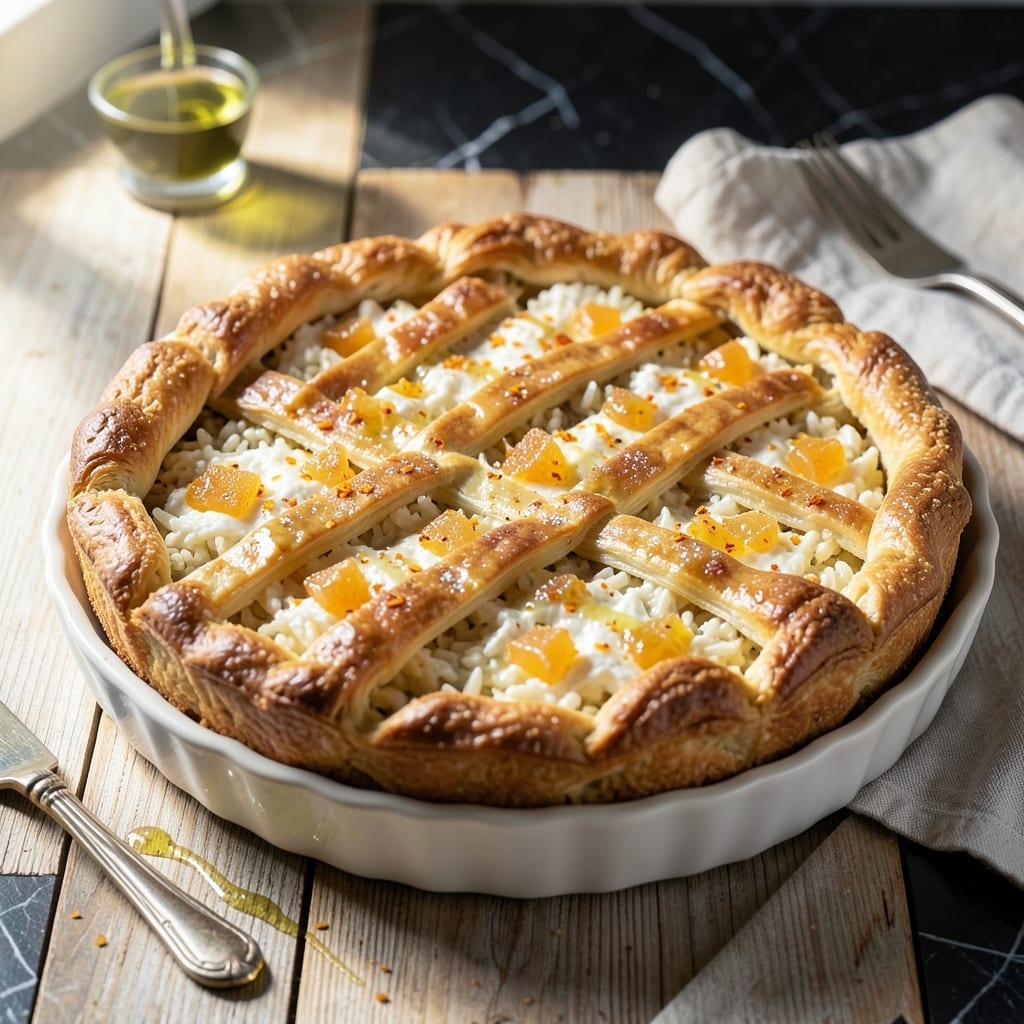
This traditional Neapolitan Easter pie represents generations of Italian baking expertise. I’ve adapted the classic wheat berry version to use rice for easier preparation without compromising authenticity.
The secret lies in properly cooking the rice until creamy, then blending it with ricotta and eggs for a dense, custard-like filling. The orange blossom water adds the signature floral note that defines this traditional dessert.
Enclosed in a buttery shortcrust pastry, the filling bakes to golden perfection. The lattice top isn’t just decorative—it creates the perfect texture contrast with the rich, traditional filling beneath.
While often reserved for Easter, this pie deserves a place at your table year-round. The rice base offers a subtle nuttiness that complements the citrus and spice notes beautifully.
Ingredients for Pastiera Napoletana Recipe with Rice
Traditional Italian ingredients create this authentic Easter pie with a rice-based filling.
| Ingredient | Amount | Notes |
|---|---|---|
| Arborio Rice 🌾 | 1 ½ cups | Uncooked, for creamy texture |
| Whole Milk Ricotta Cheese 🧀 | 2 cups | Full-fat for richness |
| Large Eggs 🥚 | 4 whole | Room temperature preferred |
| Granulated Sugar 🍚 | 1 ¼ cups | Fine grain for even mixing |
| Orange Blossom Water 🌸 | 2 tbsp | Signature floral essence |
| Candied Citron 🍈 | ½ cup | Finely chopped (key ingredient) |
| Vanilla Extract 🌿 | 1 tsp | Pure extract for depth |
| Ground Cinnamon 🌶️ | 1 tsp | Ceylon for subtlety |
| Orange Zest 🍊 | 1 tbsp | Freshly grated for brightness |
| All-Purpose Flour 🌾 | 2 ½ cups | For shortcrust pastry |
| Unsalted Butter 🧈 | 1 cup | Cold, cubed for flaky crust |
| Granulated Sugar 🍚 | ¼ cup | For pastry dough |
| Fine Sea Salt 🧂 | ½ tsp | Divided for dough and filling |
| Ice Water 💧 | 6 tbsp | For pastry binding |
| Powdered Sugar ❄️ | 2 tbsp | For dusting finished pie |
The ricotta must be whole-milk and fresh—BelGioioso or Calabria brands deliver the required density. Arborio rice, sold in most supermarkets, provides the creamy base. For orange blossom water, Cortas brand is widely available at Middle Eastern markets or online. Candied citron can be tricky; Italian specialty stores often carry it pre-diced, saving prep time.
No orange blossom water? Substitute 1 tbsp vanilla extract plus 1 tsp rose water (use sparingly). Candied citron can be replaced with equal parts candied orange peel. For a lighter texture, part-skim ricotta works but sacrifices richness. The cinnamon must be freshly ground—pre-ground loses potency quickly. Arborio rice cannot be swapped; long-grain varieties lack the necessary creaminess.
The assembled pie keeps at room temperature for 2 days. Refrigerate for up to 5 days in an airtight container. Freeze the unbaked pie for 1 month; thaw overnight before baking. Dust with powdered sugar just before serving to maintain the lattice’s crispness.
Why You’ll Love This Recipe
- No Fuss Batter: I just mix Arborio rice, ricotta, eggs, and sugar—no finicky steps or special equipment.
- Orange Blossom Magic: That floral hit from the orange blossom water makes every bite taste like a Neapolitan spring morning.
- Feeds a Crowd: One pie serves twelve, so it’s my go-to for Easter, potlucks, or any day I want to feel fancy.
- Keeps Like a Dream: Leftovers taste even better the next day, and it freezes beautifully for up to a month.
Step-by-Step Instructions for Pastiera Napoletana With Rice
Traditional method produces a rich, fragrant pie with perfect texture every time.
Step 1: Prepare the Shortcrust Pastry
In a food processor, pulse the 2.5 cups All-Purpose Flour, 0.25 cup Granulated Sugar, and a pinch of the 0.5 tsp Fine Sea Salt until combined. Add the 1 cup Unsalted Butter (cold and cubed) and pulse until the mixture resembles coarse crumbs with pea-sized butter pieces visible.
With the processor running, slowly drizzle in the 6 tbsp Ice Water through the feed tube, processing just until the dough begins to come together. I stop as soon as it forms a shaggy mass—overworking develops gluten and makes the crust tough. Turn the dough out onto a lightly floured surface and shape it into two disks, one slightly larger than the other. Wrap in plastic and refrigerate for 1 hour.
Step 2: Cook the Rice Filling Base
Rinse the 1.5 cups Arborio Rice under cold water until the water runs clear. In a saucepan, combine the rice with 2 cups of water and a pinch of the 0.5 tsp Fine Sea Salt. Bring to a boil, then reduce heat to low, cover, and simmer for 15-18 minutes until the rice is tender and the liquid is absorbed.
Spread the cooked rice on a baking sheet to cool completely. This step is crucial—adding hot rice to the filling would melt the ricotta and create a runny mixture. The rice should be at room temperature before proceeding to maintain the proper consistency of your creation.
Step 3: Combine the Filling Components
In a large bowl, whisk together the 2 cups Whole Milk Ricotta Cheese, 1.25 cups Granulated Sugar, 4 whole Large Eggs, 2 tbsp Orange Blossom Water, 1 tsp Vanilla Extract, 1 tsp Ground Cinnamon, and 1 tbsp Orange Zest until smooth and creamy.
Fold in the cooled rice and the 0.5 cup Candied Citron (finely chopped) until evenly distributed. The filling should be thick and hold its shape when spooned. I always let it rest for 15 minutes to allow the flavors to meld before assembling the pie.
Step 4: Assemble and Bake the Pastiera
On a lightly floured surface, roll out the larger pastry disk to a 12-inch circle. Transfer it to a 9-inch pie dish, pressing it gently into the bottom and up the sides. Trim any excess, leaving a ½-inch overhang. Spoon the filling into the crust, smoothing the top with a spatula.
Roll out the smaller pastry disk to a 10-inch circle. Place it over the filling and crimp the edges to seal. Use a sharp knife to cut a small cross in the center to allow steam to escape. Bake at 350°F for 1 hour to 1 hour 15 minutes until the crust is golden brown and the filling is set.
Step 5: Cool and Finish
Transfer the pastiera to a wire rack and let it cool completely in the pan, at least 2 hours. This cooling period is essential—it allows the filling to firm up properly and makes for cleaner slices.
Once cooled, dust the top with 2 tbsp Powdered Sugar through a fine-mesh sieve. Serve at room temperature. The flavors deepen after a day, so I often make this the morning before serving for optimal taste and texture.
Pro Tips For Making Pastiera Napoletana Recipe With Rice
- Cook Rice Al Dente: Arborio rice should be just tender but still firm—like 6-7 minutes in boiling water, not mushy. I learned this the hard way after ending up with a pastiera that was more porridge than pie.
- Drain Ricotta Well: Whole milk ricotta holds a lot of water, so give it a good strain in a fine-mesh sieve for 10-15 minutes. My grandmother swore by this, and she was right: it keeps the filling rich and creamy, not watery.
- Temper the Eggs: Slowly mix a bit of the warm rice into your beaten eggs before combining everything—this keeps the eggs from scrambling when they hit the hot rice. After ruining one batch, I finally figured this out.
- Use Real Orange Blossom: Skip the imitation stuff and splurge on pure orange blossom water—about 1 tablespoon is enough to perfume the whole pie. Sounds weird, but it works: the flavor is noticeably brighter and more authentic.
Regional Styles of This pastiera napoletana recipe with rice
Neapolitan Tradition
In Naples, this pie is called pastiera napoletana and is a star of Easter celebrations. The rice version, though less common than wheat berry, maintains the same rich, creamy texture that defines the classic. I love how it bridges tradition and practicality. 💛
Sicilian Adaptation
Sicily puts its spin on this pie by adding pistachios and candied orange peel to the filling. The island’s Arab influence shines through in the use of orange blossom water, which is more pronounced in their version. The crust remains buttery and flaky.
Roman Simplification
Rome often simplifies the filling, focusing on ricotta and citron without rice. Their version is lighter but still captures the floral essence. I’ve tried it both ways, and each has its charm for different occasions.
Calabrian Spice
Calabria adds warmth with extra cinnamon and a touch of clove. This southern region loves bold flavors, and their pastiera reflects that. The rice base soaks up these spices beautifully, creating a cozy, aromatic dessert.
Lombardy Variation
In the north, Lombardy sometimes replaces orange blossom water with vanilla or lemon zest. The result is a milder, citrus-forward pie that’s perfect for those who prefer subtler flavors. I find it a refreshing twist on the original.
Puglia’s Rustic Touch
Puglia often uses semolina instead of rice, giving the filling a slightly grainier texture. They also add honey for natural sweetness. It’s a rustic take that feels hearty and homey, just like their cuisine. 🌟
Nutrition Facts
Frequently Asked Questions
Can I use a different type of rice?
Stick with Arborio rice for the creamy texture. Long-grain varieties stay too firm and won’t blend smoothly with the ricotta filling.
Why does the filling need to cool before baking?
Adding hot rice to the ricotta mixture would melt the cheese, creating a runny filling that won’t set properly. Cooling ensures the perfect dense, custard-like texture.
How do I know when it’s fully baked?
The crust should be golden brown and the center should feel firm when gently pressed. Bake for 1 hour to 1 hour 15 minutes at 350°F.
Can I make this ahead of time?
The pie keeps well at room temperature for 2 days or refrigerated for 5 days. Flavors actually deepen overnight.

- Pina Colada Dip Recipe Red Lobster: Tropical Creaminess With Toasted Coconut - October 12, 2026
- Pickled Sweet Cherry Peppers Recipe Canning: Tangy Heat for Pantry Staples - October 12, 2026
- Peppercorn Sauce Recipe Vegan: Rich Umami Depth Without Cream - October 12, 2026