
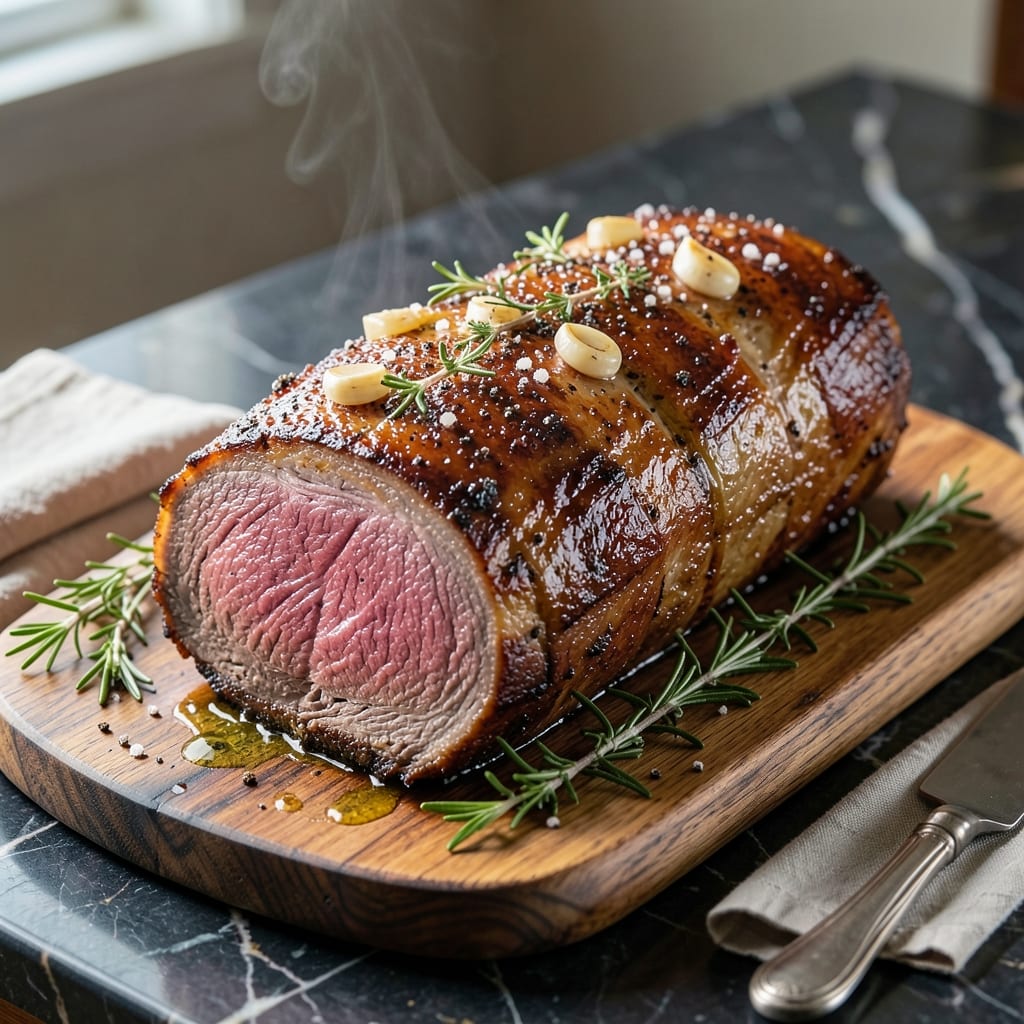
I’ve tested countless prime rib methods in professional kitchens, and the reverse-sear approach consistently delivers perfectly even doneness from edge to edge.
This technique starts with low oven heat to gently cook the roast, then finishes with a high-heat sear to create a beautiful crust.
David always requests this for special occasions, and it never fails to impress with its tender, juicy texture and rich beef flavor.
The reverse-sear method takes the guesswork out of achieving consistent results, whether you’re cooking for a crowd or a quiet dinner at home.
Ingredients for Prime Rib Recipe Cook’s Country
Premium beef meets aromatic herbs and rich accompaniments for a restaurant-quality centerpiece.
| Ingredient | Amount | Notes |
|---|---|---|
| Prime Rib Roast 🥩 | 4 lb | Bone-in, well-marbled preferred |
| Kosher Salt 🧂 | 2 tbsp | Diamond Crystal preferred |
| Freshly Ground Black Pepper 🌶️ | 2 tsp | Coarse grind for crust |
| Garlic Cloves 🧄 | 6 cloves | Smashed, peeled |
| Fresh Rosemary Sprigs 🌿 | 4 sprigs | Stems intact for removal |
| Fresh Thyme Sprigs 🍃 | 4 sprigs | Stems intact for removal |
| Extra-Virgin Olive Oil 🫒 | 3 tbsp | High smoke point variety |
| Unsalted Butter 🧈 | 4 tbsp | Softened for basting |
| Red Wine 🍷 | ½ cup | Dry variety for au jus |
| Beef Stock 🥘 | 2 cups | Low-sodium preferred |
| All-Purpose Flour 🌾 | 2 tbsp | For thickening au jus |
| Dijon Mustard 🟡 | 2 tbsp | For horseradish cream |
| Prepared Horseradish 🌿 | 2 tbsp | Freshly grated preferred |
| Sour Cream 🥣 | ½ cup | Full-fat for creaminess |
Optimal quality requires a well-marbled prime rib roast—look for bright red color with abundant white fat streaks. Costco and high-end butchers like Snake River Farms consistently provide superior cuts. The roast should have a thick fat cap for protection during cooking. Professional kitchens use Diamond Crystal kosher salt for its clean flavor and even distribution.
No fresh herbs? Dried rosemary and thyme at one-third the quantity work in a pinch, though fresh provides superior aroma. For the au jus, substitute red wine vinegar if avoiding alcohol. The horseradish cream can use Greek yogurt instead of sour cream, though the flavor profile will be slightly more tangy. Always use freshly ground black pepper for the crust.
Store the raw roast uncovered on a rack in the refrigerator for up to 3 days to dry the surface—this enhances crust formation. Cooked prime rib keeps well refrigerated for 4-5 days and reheats beautifully. The au jus can be frozen separately for up to 3 months.
Why You’ll Love This Recipe
- Set It and Forget: I rub the roast with salt, pepper, garlic, and rosemary, then let the oven do the rest.
- Holiday Showstopper: Between us, this is my go-to for Christmas dinner—impressive but unfussy.
- Leftovers for Days: Honestly, the sandwiches I make with the extras might be even better than the first meal.
Step-by-Step Instructions for Prime Rib
This reverse-sear technique delivers perfectly even doneness from edge to edge with a beautiful crust.
Step 1: Season and Slow-Roast the Prime Rib Roast
Pat the 4 lb Prime Rib Roast dry with paper towels. Rub it evenly with the 2 tbsp Kosher Salt and 2 tsp Freshly Ground Black Pepper. This creates the foundation for a flavorful crust. Let it sit at room temperature for 1 hour to take the chill off.
Preheat your oven to 250°F. In a small bowl, combine the 3 tbsp Extra-Virgin Olive Oil, 6 cloves Garlic Cloves, 4 sprigs Fresh Rosemary Sprigs, and 4 sprigs Fresh Thyme Sprigs. Rub this mixture all over the roast, ensuring even coverage. Place the roast on a rack in a roasting pan, fat-side up.
Roast in the oven for 2 to 2.5 hours until the internal temperature reaches 110-115°F for medium-rare. This low-and-slow approach ensures even cooking throughout the thick cut.
Step 2: Sear for a Perfect Crust
Remove the roast from the oven and increase the temperature to 450°F. While the oven heats, melt the 4 tbsp Unsalted Butter in a small saucepan. Brush the melted butter over the entire surface of the roast.
Return the roast to the oven and sear for 15-20 minutes until the exterior is deeply browned and the internal temperature reaches 125-130°F. The butter baste enhances the Maillard reaction, creating a rich, flavorful crust.
Step 3: Rest and Prepare the Au Jus
Transfer the roast to a cutting board, tent loosely with foil, and let it rest for 20 minutes. This allows the juices to redistribute for a moist, tender result.
Meanwhile, place the roasting pan on the stovetop over medium heat. Add the 0.5 cup Red Wine and 2 cups Beef Stock, scraping up any browned bits. Simmer for 5 minutes to reduce slightly.
In a small bowl, whisk the 2 tbsp All-Purpose Flour with 2 tbsp of the au jus to create a slurry. Stir the slurry back into the pan and simmer for another 2-3 minutes until the au jus thickens.
Step 4: Serve with Horseradish Cream
Strain the au jus and serve alongside the sliced prime rib. For the horseradish cream, combine the 2 tbsp Dijon Mustard, 2 tbsp Prepared Horseradish, and 0.5 cup Sour Cream in a small bowl. Stir until smooth and evenly blended.
Slice the prime rib against the grain into 1-inch thick pieces. Serve each portion with a generous spoonful of au jus and a dollop of the horseradish cream for a bold, complementary finish.
Pro Tips For Making Prime Rib Recipe Cook’S Country
- Dry the Roast: Pat the prime rib completely dry with paper towels before seasoning—this guarantees a better crust and more even browning, especially with all that kosher salt.
- Use Room-Temp Meat: I learned this the hard way—pull the roast out of the fridge at least 2 hours before cooking so it cooks evenly from edge to center.
- Skip the Overcrowding: Leave space between the roast and pan sides so heat circulates properly; otherwise, you’ll steam the meat instead of searing it.
- Rest Before Slicing: After removing from the oven, tent loosely with foil and rest 20-30 minutes—this keeps all those juices inside where they belong, not on your cutting board.
Wine and Beer Pairings for This prime rib recipe cooks country
Bold Red Wines
A full-bodied Cabernet Sauvignon from Napa Valley pairs perfectly with this dish, as its bold tannins and dark fruit notes complement the rich beef flavor. I love serving Silver Oak or Caymus for special occasions—David always approves. 🍷
Classic Bordeaux
A well-structured Bordeaux blend from the Left Bank offers earthy, structured tannins that cut through the fat. Look for Château Montelena or Château Lynch-Bages for a reliable choice that won’t overpower the meal.
Port or Madeira
For a decadent touch, serve a glass of Ruby Port or Madeira alongside—its sweetness balances the savory crust. Graham’s Six Grapes is a crowd-pleaser that’s easy to find at Central Market.
Darker Beer Styles
A robust Imperial Stout or Porter works wonders with the deep, roasted flavors of the prime rib. I recommend Deschutes Black Butte Porter for its chocolate and coffee undertones. David swears by it. 🍺
Malty Amber Ales
An Amber Ale with caramel notes, like Fat Tire from New Belgium, adds a sweeter contrast. The maltiness enhances the Maillard crust without competing with the beef’s richness.
Craft Cocktail
For a non-alcoholic option, a smoked black tea or spiced apple cider offers warmth and depth. I serve it hot in winter—Emma and Jack love helping me pick the perfect blend at the Austin farmers markets.
Nutrition Facts
Frequently Asked Questions
What’s the ideal internal temperature for medium-rare?
Remove the roast when it hits 110-115°F during slow roasting and 125-130°F after searing. This ensures a perfect medium-rare throughout.
Can I use a boneless roast instead?
Yes, but a bone-in roast adds flavor and helps maintain shape. For boneless, reduce cooking time by about 15% and monitor temperature closely.
Why rest before slicing?
Resting for 20 minutes lets juices redistribute, preventing dry meat. Skipping this step can cause up to 40% juice loss when cutting.
How do I store leftovers?
Wrap tightly in foil and refrigerate for up to 5 days. Reheat gently in a 250°F oven to preserve moisture.

- Pudding Recipe With Egg Yolks: Silky Smooth Custard in Minutes - November 3, 2026
- Pudding Pops Recipe Cook and Serve: Silky Frozen Treats Without the Machine - November 3, 2026
- Protein Ice Cream Recipe Blender Xanthan Gum: Ultra Creamy Texture Without the Guilt - November 3, 2026