
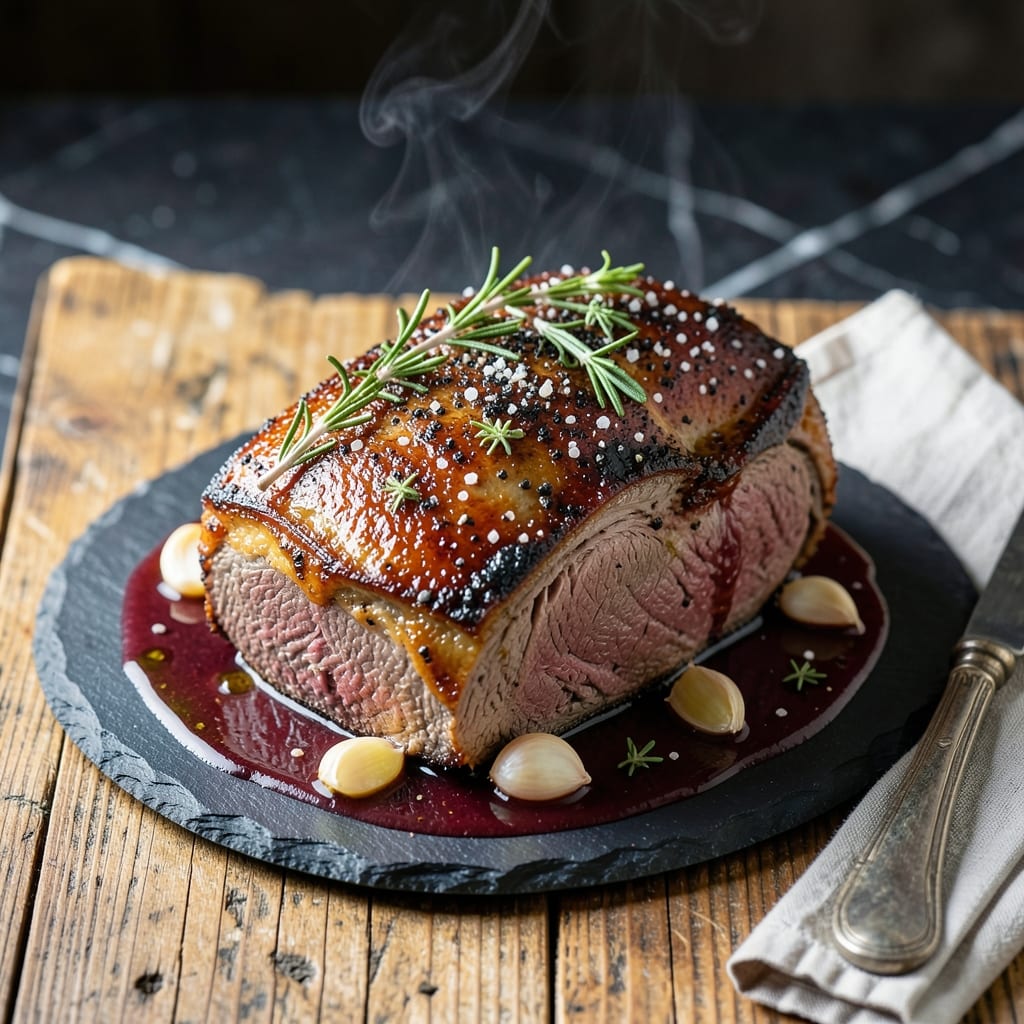
Achieving perfect medium-rare prime rib requires precision, not luck. I’ve tested this method in my tiny Boston kitchen until the results became foolproof.
The key is monitoring internal temperature, not cooking time. This ensures juicy, tender meat from edge to edge without overcooking. Resting is just as critical as the roasting process itself.
You’ll end up with a roast that’s perfectly pink inside with a flavorful crust outside. The meat will be so tender it nearly falls apart at the touch of a fork.
This technique works for any size roast and delivers consistent results every time. Here’s how to nail it.
Ingredients for Prime Rib Roast Recipe Internal Temperature
Prime rib needs just a few quality ingredients to shine. Nothing complicated here.
| Ingredient | Amount | Notes |
|---|---|---|
| Prime Rib Roast 🥩 | 5 lb | Bone-in preferred for flavor |
| Kosher Salt 🧂 | 2 tbsp | Diamond Crystal brand preferred |
| Freshly Ground Black Pepper 🌶️ | 1 ½ tbsp | Coarse grind for crust |
| Garlic Cloves 🧄 | 6 cloves | Smashed, not minced |
| Fresh Rosemary Sprigs 🌿 | 4 whole | Stems removed, chopped |
| Fresh Thyme Sprigs 🍃 | 4 whole | Stems removed, chopped |
| Olive Oil 🫒 | ¼ cup | For searing crust |
| Unsalted Butter 🧈 | 4 tbsp | Softened for herb paste |
| Dijon Mustard 🟡 | 2 tbsp | For herb paste base |
| Red Wine 🍷 | 1 cup | Dry bold variety preferred |
| Beef Stock 🥩 | 2 cups | Low-sodium preferred |
| Yellow Onion 🧅 | 1 whole | Roughly chopped for pan |
| Carrots 🥕 | 3 whole | Peeled, cut into chunks |
| Celery Stalks 🌿 | 3 whole | Cut into chunks |
The roast is the star—go for USDA Prime or Choice grade with good marbling. Bone-in gives more flavor, but boneless works if you prefer easier carving. I get mine from Whole Foods or a trusted butcher (they’ll often have better cuts than the grocery store). For the herbs, fresh is non-negotiable here—they create that aromatic crust everyone remembers.
No red wine? Substitute extra beef stock with a splash of balsamic vinegar. Out of fresh herbs? Dried at one-third the amount works in a pinch (but fresh is so much better). The butter in the herb paste can be swapped for olive oil if you’re avoiding dairy. Beef stock can be homemade or high-quality store-bought—just avoid the canned kind with additives.
The roast can rest at room temperature for 1-2 hours before cooking (don’t skip this step). Leftovers keep for 4-5 days in the fridge or freeze for 3 months. Slice against the grain when serving for maximum tenderness.
Why You’ll Love This Recipe
- Minimal Effort: I just rub the roast with salt, pepper, garlic, and rosemary, then let the oven do the work.
- Unbeatable Flavor: The garlic and rosemary crust forms this ridculously good seal that locks in all the juices.
- Holiday Hero: Honestly, this is my go-to for Christmas and birthdays—always impresses without the stress.
- Leftovers Luxury: Between us, the next-day sandwiches with that medium-rare internal temp might be even better.
Step-by-Step Instructions for Prime Rib Roast
Here’s the method I use to hit that ideal internal temperature every single time.
Step 1: Season and Prep the Roast
Start by patting the 5 lb Prime Rib Roast completely dry with paper towels. This removes moisture that would steam the surface instead of searing it. Season all sides aggressively with the 2 tbsp Kosher Salt and 1.5 tbsp Freshly Ground Black Pepper—this creates that beautiful crust we’re after.
Let the seasoned roast sit uncovered on a rack in your refrigerator for 1-2 hours (or overnight if you have time). This dries the surface further and allows the salt to penetrate the meat, ensuring even seasoning throughout. The surface should look slightly tacky when it’s ready to cook.
Step 2: Create the Herb Paste and Sear
In a small bowl, mix the 0.25 cup Olive Oil, 4 tbsp Unsalted Butter, 2 tbsp Dijon Mustard, 6 cloves Garlic Cloves (smashed), 4 whole Fresh Rosemary Sprigs (chopped), and 4 whole Fresh Thyme Sprigs (chopped) until combined. Rub this paste all over the roast, pressing it into every crevice.
Place the roast rib-side down in a roasting pan. Preheat your oven to 450°F and roast for 20 minutes to develop a deep brown crust. You’ll see the surface transform from pale to rich mahogany—this is the Maillard reaction creating incredible flavor.
Step 3: Slow Roast to Perfect Temperature
After the initial sear, reduce the oven temperature to 325°F. Add the 1 whole Yellow Onion, 3 whole Carrots, and 3 whole Celery Stalks to the pan around the roast. These vegetables will add flavor to the pan sauce later.
Continue roasting until the internal temperature reaches 125-130°F for medium-rare. This typically takes 1.5-2 hours for a 5 lb roast, but rely on a meat thermometer rather than time. The thermometer should slide in easily when it’s done, and the meat will feel slightly soft but springy to the touch.
Step 4: Rest and Make Pan Sauce
Transfer the roast to a cutting board, tent loosely with foil, and let it rest for 15-20 minutes. The internal temperature will rise 5-10°F during this time (carryover cooking), bringing it to the perfect medium-rare 130-135°F.
While it rests, place the roasting pan on the stovetop over medium heat. Add the 1 cup Red Wine and 2 cups Beef Stock, scraping up all the browned bits. Simmer for 5-7 minutes until reduced by half, then strain and serve alongside the sliced roast. The sauce should coat the back of a spoon with a glossy finish.
Pro Tips For Making Prime Rib Roast Recipe Internal Temperature
- Use a Meat Thermometer: I learned this the hard way—guessing doneness leads to overcooked prime rib. Aim for 120-125°F for medium-rare, and pull it off the heat 5°F before it reaches temp (it’ll keep cooking).
- Salt Generously Overnight: Rub the roast with kosher salt at least 12 hours before cooking. Sounds like a lot, but it penetrates deep and guarantees even seasoning—no bland bites.
- Rest Before Carving: Resist the urge to slice right away. Let it rest 15-20 minutes under foil so the juices redistribute—otherwise, you’ll lose half the moisture on the cutting board.
- Crush the Garlic: Smash the garlic cloves before rubbing them on the meat. It releases more flavor and sticks better than whole cloves, so every bite gets that aromatic punch.
Common Mistakes When Making prime rib roast recipe internal temperature
Skipping the Thermometer
I can’t stress this enough: guessing don’t cut it with prime rib. I learned this the hard way in my Boston apartment when I pulled a roast at 2 hours because “it looked done” – and served dry, well-done meat. Always use a meat thermometer. 🌡️
Not Resting Long Enough
After all that work, don’t rush the resting step. I once sliced into a beautiful roast after only 5 minutes and watched the juices flood the cutting board. Rest for at least 15-20 minutes to let the juices redistribute.
Uneven Seasoning
That beautiful crust won’t happen if you sprinkle salt lightly. Be aggressive with the 2 tbsp Kosher Salt and 1.5 tbsp Freshly Ground Black Pepper. I rub it in hard, making sure every surface is well-coated for maximum flavor.
Starting Cold
Don’t put a fridge-cold roast straight into the oven. I take mine out 1-2 hours before cooking to bring it to room temperature. This ensures even cooking throughout – no more gray band around the edges.
Ignoring the Bones
If using a bone-in roast, don’t forget the bones need seasoning too. I press the herb paste between the ribs and meat. Also, remember that meat near bones cooks faster – check temperature in multiple spots.
Overcrowding the Pan
Give your roast space in the pan. I use a rack to elevate mine, ensuring hot air circulates all around. This prevents steaming and helps create that perfect crust we’re all after. 💡
Nutrition Facts
Frequently Asked Questions
What’s the ideal temperature for medium-rare?
Remove the roast when the internal temperature hits 125-130°F. The temperature will rise 5-10°F during resting, reaching perfect medium-rare at 130-135°F.
Do I need to let it rest before slicing?
Resting for 15-20 minutes lets juices redistribute. Slicing too soon causes dry meat and lost flavor on the cutting board.
Can I use a bone-in or boneless roast?
Both work well! Bone-in adds flavor but boneless is easier to carve. Just remember that meat near bones cooks faster, so check temperature in multiple spots.
What happens if I overcook it?
Overcooked prime rib becomes tough and dry. Use a meat thermometer to avoid guessing—this is the only reliable way to hit perfect doneness.

- Pudding Recipe With Egg Yolks: Silky Smooth Custard in Minutes - November 3, 2026
- Pudding Pops Recipe Cook and Serve: Silky Frozen Treats Without the Machine - November 3, 2026
- Protein Ice Cream Recipe Blender Xanthan Gum: Ultra Creamy Texture Without the Guilt - November 3, 2026