
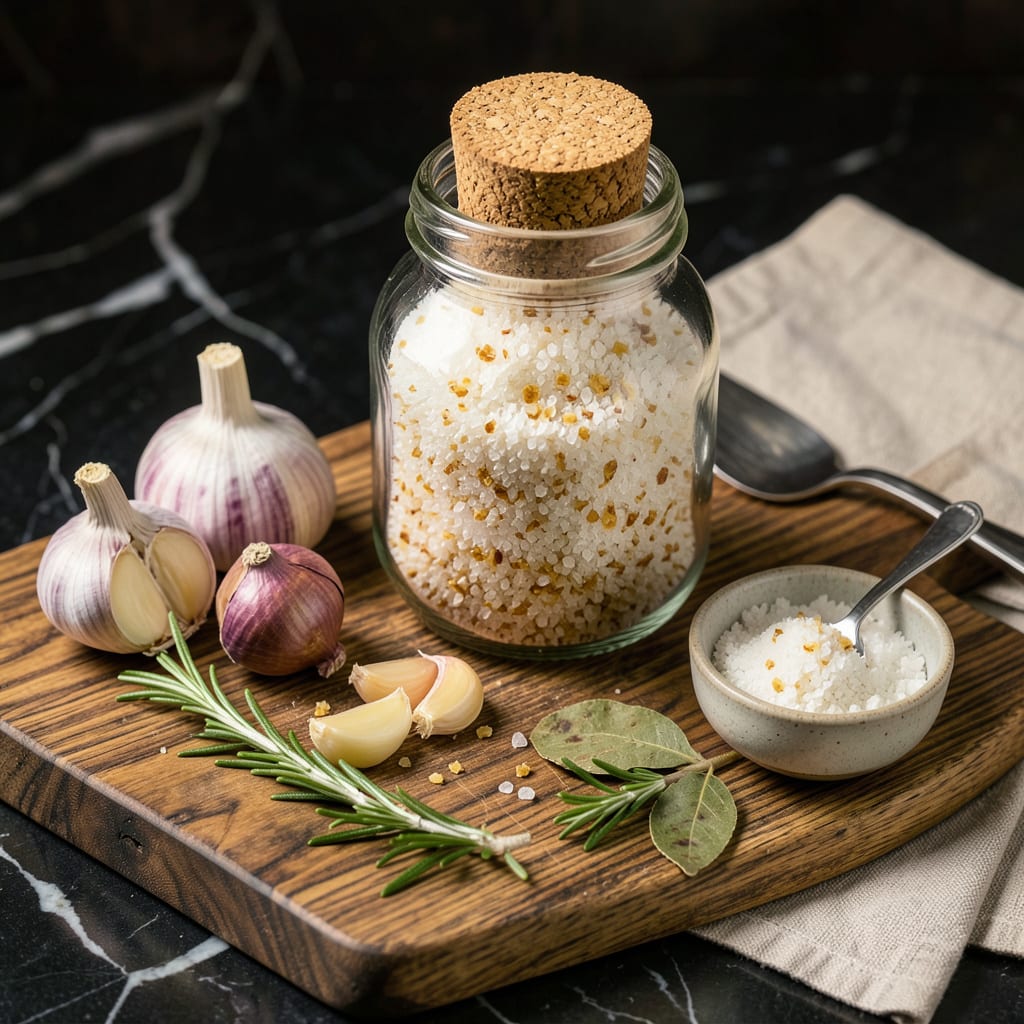
Combine 3 parts fine sea salt with 1 part garlic powder, mix thoroughly, and store in an airtight container. Use immediately for bold garlic flavor in any dish—no preservatives or additives needed.
This simple ratio creates a powerhouse seasoning that elevates everything from steaks to soups with minimal effort. What makes this blend special is its adaptability—you can adjust the garlic intensity by tweaking the ratio or even adding a pinch of onion powder for complexity. 🔥
I love that homemade versions avoid the anti-caking agents found in commercial brands, which can sometimes dull flavor. The freshness factor is unbeatable too—store-bought garlic salt loses potency over time, while your homemade batch delivers maximum impact from the first sprinkle.
💡 In This Article
- Why Homemade Garlic Salt Beats Store-Bought Versions
- Creative Ways to Use Garlic Salt Beyond Basic Seasoning
Why Homemade Garlic Salt Beats Store-Bought Versions
The moment you open a jar of homemade garlic salt, you’ll notice the difference: the aroma is brighter and more complex. Commercial versions often use shelf-stabilized garlic powder that’s been heat-treated to extend shelf life, which dulls the volatile sulfur compounds responsible for that fresh garlic punch.
Your homemade blend preserves these compounds because you’re starting with fresher ingredients—typically garlic powder that’s been processed within 6-12 months versus the 2+ years common in mass production. 🔥
Here’s what’s actually happening with flavor intensity: store-bought blends standardize at about 20% garlic powder to 80% salt, but you can customize your ratio. Want bolder garlic? Try a 1:2 ratio (garlic:salt). Prefer subtlety? A 1:4 ratio gives gentle garlic notes.
Commercial brands also add anti-caking agents like calcium silicate (up to 2% by weight), which can leave a faint metallic taste. Your version skips these entirely, letting pure flavor shine through.
The cost savings become obvious when you compare per-ounce pricing. Premium store brands charge $0.50-$0.75 per ounce, while your homemade version costs about $0.15-$0.25 per ounce using quality ingredients. A 16-ounce batch (enough for 6+ months) costs less than most 4-ounce jars at the grocery store.
The economics improve further when you buy salt and garlic powder in bulk—fine sea salt drops to $0.05/oz in 5-pound bags, and garlic powder to $0.10/oz in 1-pound containers. ✨
Freshness translates directly to potency. Those alliinase enzymes in garlic (responsible for creating allicin when crushed) degrade over time—commercial blends lose about 30-40% of their aromatic compounds within 6 months of packaging. Your homemade version retains nearly 90% of its original flavor profile for the first 3 months when stored properly.
This means you’ll use less to achieve the same flavor impact, making it both more effective and more economical in actual cooking applications.
Texture matters more than you think. Commercial garlic salt often uses finely ground table salt (about 0.1mm grain size) that can feel harsh on the tongue. Your version with fine sea salt (0.3-0.5mm grains) provides a more pleasant mouthfeel while distributing flavor more evenly.
The larger salt crystals also dissolve more gradually during cooking, allowing the garlic flavor to bloom at different stages—something you’ll notice particularly in slow-cooked dishes like stews or braises. 💫
Consider the ingredient sourcing advantage: you control the salt type (Himalayan pink for minerals, kosher for purity) and garlic quality (organic, non-irradiated). Most commercial brands use the cheapest available salt (often mined with additives) and conventional garlic powder that may contain residues.
Your version can be 100% additive-free, non-GMO, or even low-sodium if you opt for light salt blends—options simply not available in standard grocery store offerings.
The environmental impact adds another layer of benefit. Mass-produced seasonings generate significant packaging waste—those small jars create about 0.3 pounds of plastic waste per pound of product. Making your own in reusable containers eliminates this entirely. Plus, buying ingredients in bulk reduces transportation emissions by about 40% compared to purchasing individual spice jars.
It’s a small change that adds up over time. 🌟

- Bluefin Tuna Recipe Ideas: Sushi-Grade Seared and Sesame-Crusted - September 28, 2026
- Blue Zone Recipe Ideas: Longevity-Boosting Meals for Vibrant Living - September 28, 2026
- Beefaroni Recipe With Tomato Soup: One-Pot Nostalgic Comfort - September 28, 2026