
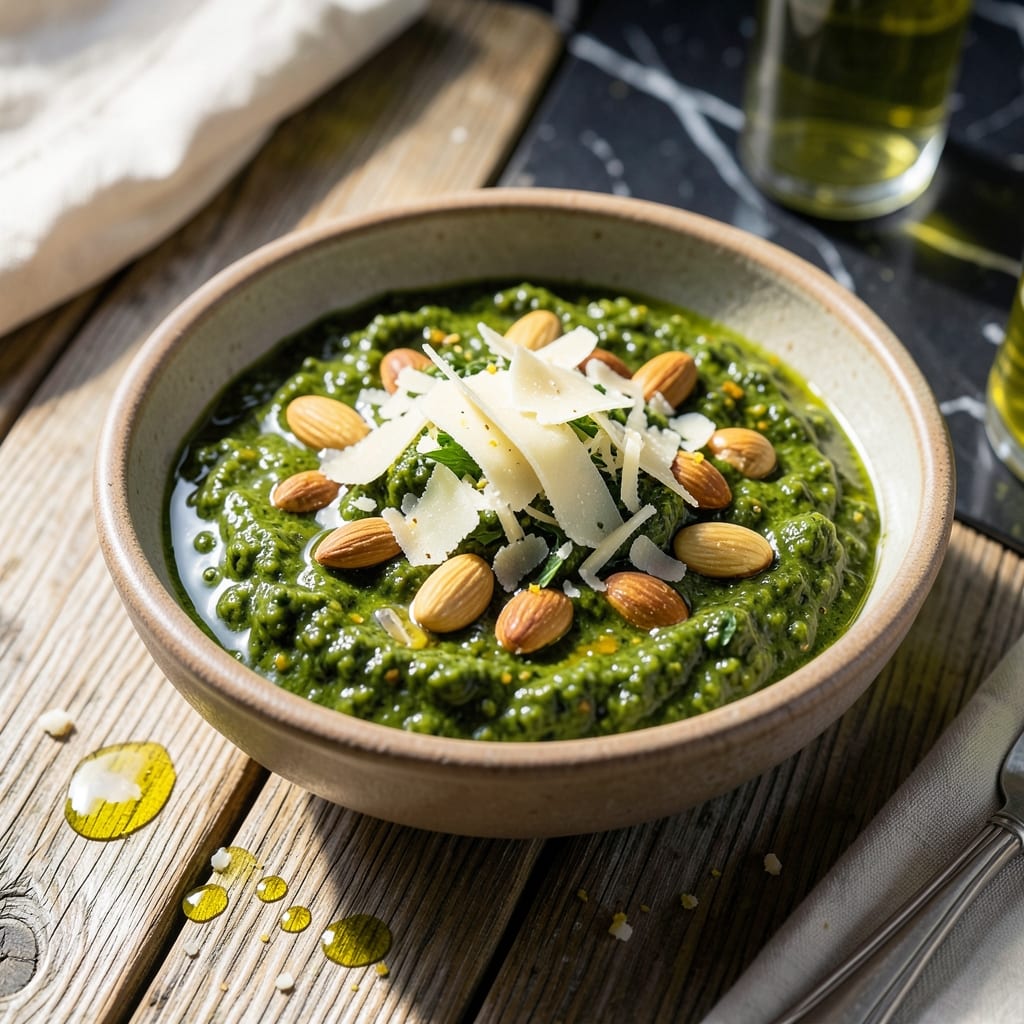
This almond pesto delivers a rich, nutty twist on the classic basil sauce you know and love. I developed this version to add depth while keeping the bright, fresh flavors that make pesto so versatile.
The almonds create a creamier texture than pine nuts, with a subtler sweetness that pairs perfectly with garlic and parmesan. A quick spin in the food processor transforms simple ingredients into a vibrant smooth paste ready for pasta, sandwiches, or dipping.
What you get is a sauce that’s boldly flavorful yet balanced, with the almonds adding body without overpowering the basil. The best part? It comes together in 10 minutes with minimal effort.
Use it immediately or store in the fridge for up to a week. Here’s how to make this nutty pesto.
Ingredients for Pesto Sauce Recipe with Almonds
Eight ingredients transform into this vibrant nutty pesto sauce in minutes.
| Ingredient | Amount | Notes |
|---|---|---|
| Fresh Basil Leaves 🌿 | 2 cups | Packed, stems removed |
| Raw Almonds 🥜 | ½ cup | Toasted for depth |
| Parmesan Cheese 🧀 | ¾ cup | Freshly grated preferred |
| Garlic Cloves 🧄 | 3 cloves | Peeled, rough chopped |
| Extra-Virgin Olive Oil 🫒 | ¾ cup | High quality, fruity |
| Lemon Juice 🍋 | 1 tbsp | Freshly squeezed |
| Sea Salt 🧂 | ½ tsp | Fine grain preferred |
| Black Pepper 🌶️ | ¼ tsp | Freshly ground |
The almonds are the star here—raw almonds from Trader Joe’s or Costco work perfectly. Toast them lightly to bring out their natural sweetness (just until fragrant, not browned). For the basil, farmers market finds have more aroma than grocery store clamshells, but either works if the leaves are bright green and perky. The Parmesan needs to be the real deal Parmigiano-Reggiano—pre-grated won’t melt as smoothly.
No almonds? Walnuts or cashews give a similar creamy texture. Short on basil? Stretch it with fresh parsley (up to half and half). Want it sharper? Pecorino Romano instead of Parm. The olive oil should be something you’d happily drizzle on bread—those peppery, assertive ones can overpower. If you’re out of lemon juice, a splash of white wine vinegar works in a pinch.
Pesto browns fast, so pour a thin layer of olive oil on top before sealing. Good for 1 week in the fridge, 6 months frozen. Ice cube trays are perfect for single portions (worth the extra minute).
Why You’ll Love This Recipe
- One-Bowl Wonder: I just toss everything in the food processor—basil, almonds, parmesan, garlic, oil—and it’s done. No fancy prep, no mess.
- Nutty Richness: The almonds add this deep, buttery crunch that makes it way more interesting than plain pine nut pesto.
- Pasta to Salad: I slather it on sandwiches, mix it into pasta, or drizzle over roasted veggies. It never gets old.
- Budget Stretch: Raw almonds cost half what pine nuts do, and honestly, I can’t tell the difference in flavor. Leftovers keep a week in the fridge.
Step-by-Step Instructions for Pesto Sauce With Almonds
This method transforms simple ingredients into a vibrant, nutty sauce with perfect texture every time.
Step 1: Toast the Almonds for Depth
Heat a dry skillet over medium heat until warm. Add the 0.5 cup Raw Almonds and toast for 3-5 minutes, stirring frequently, until they turn light golden brown and become fragrant. You’ll notice the nuts start to make a subtle crackling sound—that’s your audio cue they’re ready.
Immediately transfer the toasted almonds to a plate to cool. This stops the cooking process and prevents them from becoming bitter. I always let them cool completely before blending; hot nuts can make your pesto oily instead of creamy.
Step 2: Pulse the Base Ingredients
In a food processor, combine the cooled 0.5 cup Raw Almonds, 3 cloves Garlic Cloves, and 0.5 tsp Sea Salt. Pulse for 10-15 seconds until the mixture resembles coarse crumbs. You want some texture here—not a fine powder.
Add the 2 cups Fresh Basil Leaves and pulse again in 5-second bursts until the basil is finely chopped and incorporated with the almonds. The leaves should be broken down but still have some visible flecks for visual appeal. Stop before it becomes a solid green paste.
Step 3: Emulsify with Cheese and Oil
Sprinkle the 0.75 cup Parmesan Cheese over the almond-basil mixture and pulse briefly to combine. With the processor running, slowly drizzle in the 0.75 cup Extra-Virgin Olive Oil through the feed tube. This gradual addition creates a stable emulsion.
The mixture will transform from a dry, crumbly texture to a smooth, glossy sauce. You’ll see it cling to the sides of the processor bowl when it’s properly emulsified. Stop and scrape down the sides as needed to ensure everything incorporates evenly.
Step 4: Finish and Adjust Seasoning
Add the 1 tbsp Lemon Juice and 0.25 tsp Black Pepper, then pulse for 3-5 seconds to combine. The lemon juice brightens the flavors and helps preserve the vibrant green color.
Taste and adjust seasoning if needed. I sometimes add a pinch more salt or a squeeze of lemon for balance. For the best texture, let the pesto rest at room temperature for 10-15 minutes before using. This allows the flavors to meld and the sauce to thicken slightly.
Pro Tips For Making Pesto Sauce Recipe With Almonds
- Toast the Almonds: Lightly toasting the raw almonds in a dry pan for 3-4 minutes brings out their nutty flavor—skip this and your pesto will taste flat. I learned this the hard way after making bland batches.
- Blanch the Basil: Dunk fresh basil leaves in boiling water for 10 seconds then ice bath to lock in that bright green color. Sounds weird, but it works and keeps your pesto vibrant, not dull.
- Skip the Food Processor: Use a mortar and pestle or pulse very briefly—over-processing turns pesto bitter and gluey. After ruining a batch, I finally figured out less is more.
- Grate the Parmesan Fresh: Pre-grated parmesan has anti-caking agents that make pesto grainy. About 1/2 cup freshly grated—enough to add richness without overpowering the basil.
Essential Equipment for Great pesto sauce recipe with almonds
Food Processor
A 7-10 cup food processor is essential for proper texture—I use my Cuisinart DFP-14BCNY for its powerful motor and large capacity. The blade should be sharp to cleanly chop the almonds and basil without bruising.
Skillet for Toasting
Any heavy-bottomed skillet works for toasting almonds, but I prefer my Lodge cast iron for even heat distribution. Avoid nonstick if you can, as the nuts may not brown as evenly. 🔥
A medium heat setting gives you the control needed to toast without burning.
Measuring Tools
Accurate measurements matter for balance. I use OXO Good Grips measuring cups for dry ingredients and a 1 tbsp measure for the lemon juice. A kitchen scale helps for the Parmesan if you want precision.
Spatula
A silicone spatula is perfect for scraping down the processor bowl between pulses. It’s heat-resistant and won’t scratch your processor’s work bowl. I keep one dedicated just for this purpose.
Storage Containers
For fridge storage, use small glass jars with tight lids—I love Ball mason jars. For freezing, silicone ice cube trays portion perfectly. Always cover the surface with a thin layer of olive oil to prevent browning. ❄️
Nutrition Facts
Frequently Asked Questions
Can I use other nuts instead of almonds?
Walnuts or cashews work well for a similar creamy texture. Pine nuts are traditional but pricier. For a stronger flavor, try pecans or hazelnuts in the same 0.5 cup amount.
How long does almond pesto keep?
In the fridge, it stays fresh for 1 week in an airtight container with oil on top. For longer storage, freeze in ice cube trays for up to 6 months. Thaw overnight before using.
Why did my pesto turn brown?
Browning happens when basil oxidizes. Prevent it by pressing plastic wrap directly on the surface or adding extra olive oil. Lemon juice in the recipe also helps slow discoloration.

- Potato Candy Recipe 1933: Vintage Peanut Butter Roll Delight - October 30, 2026
- Potato Chip Cookie Recipe With Pecans: Buttery Crunch Meets Nutty Richness - October 30, 2026
- Potato Patty Recipe No Egg: Crispy Edges Without the Binder - October 30, 2026