
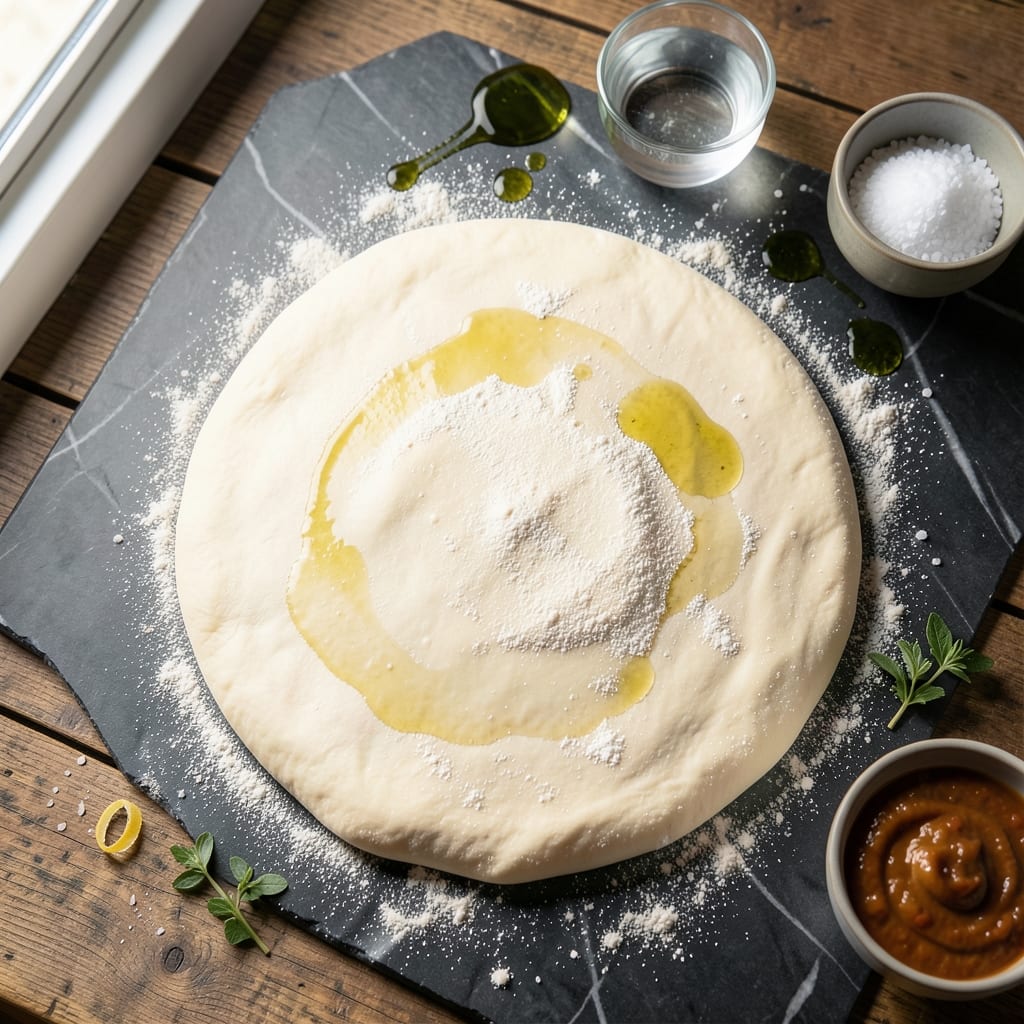
There’s a reason my grandmother in Sicily swore by cold-fermented dough. This method develops complex flavors that quick rises simply can’t match.
I’ve spent years perfecting this 24-hour technique, which creates a crust with the perfect balance of chewiness and crispness. The slow fermentation allows the gluten to develop naturally without over-kneading.
What emerges is dough with beautiful air pockets and a subtle tang that elevates any toppings you choose. The extended rest time also makes the dough easier to handle and shape.
This foundation delivers restaurant-quality results with minimal effort. The wait is worth it for the flavor payoff.
Ingredients for Pizza Dough Recipe Top Rated
Nine ingredients for dough that tastes like a Sicilian nonna made it.
| Ingredient | Amount | Notes |
|---|---|---|
| Bread Flour 🌾 | 4 cups | High-protein for chewy texture |
| Active Dry Yeast 🍞 | ¼ tsp | Proofed in warm water |
| Fine Sea Salt 🧂 | 2 tsp | Diamond Crystal preferred |
| Extra-Virgin Olive Oil 🫒 | 2 tbsp | For dough elasticity |
| Ice-Cold Water 💧 | 1 ½ cups | Divided for yeast and dough |
| Granulated Sugar 🍚 | 1 tsp | Feeds yeast activation |
| Semolina Flour 🌾 | ½ cup | For dusting work surface |
| Cornmeal 🌽 | ¼ cup | Prevents sticking on peel |
| All-Purpose Flour 🌾 | ½ cup | For adjusting dough consistency |
The flour is non-negotiable here. King Arthur Bread Flour has the protein content (12-14%) you need for that chewy, elastic crust—all-purpose just won’t cut it. I grab mine from Whole Foods or order online in bulk. The yeast? SAF Instant if you can find it, but any active dry works fine. That ice-cold water is key for the 24-hour ferment—don’t skimp on the chill.
No bread flour? Substitute half with vital wheat gluten (1 tbsp per cup of all-purpose) to boost protein. Sugar can be honey at the same amount, but stick to granulated for consistency. The olive oil? Use something good—this isn’t the place for that dusty bottle in the back of your cabinet. Semolina and cornmeal can be swapped for each other in a pinch, but semolina gives better texture.
The dough balls freeze beautifully—3 months in an airtight bag. Thaw overnight in the fridge before shaping. Fresh dough keeps 5 days refrigerated (it’ll actually improve flavor). Always bring to room temp before stretching—cold dough tears easily.
Why You’ll Love This Recipe
- Five-Ingredient Magic: I just dump bread flour, yeast, salt, olive oil, and ice water—no fancy steps, no stress.
- Crisp Yet Chewy: That olive oil gives it a rich depth, while the cold water trick makes the crust crackly outside, soft inside.
- Freezer’s Best Friend: I roll out a double batch on Sunday, freeze half, and pull it straight to the oven on busy nights.
- Penny-Pincher’s Dream: A pound of bread flour and a packet of yeast cost less than a takeout pie and taste infinitely better.
Step-by-Step Instructions for Pizza Dough
This is my tested method for developing complex flavor through extended fermentation.
Step 1: Activate the Yeast with Sugar and Warm Water
Combine the 0.25 tsp Active Dry Yeast, 1 tsp Granulated Sugar, and ¼ cup of the 1.5 cups Ice-Cold Water (heated to 110-115°F) in a small bowl. Let it sit for 5-10 minutes until foamy and bubbly—this confirms your yeast is alive and active.
I always check the water temperature with an instant-read thermometer. Too hot and you’ll kill the yeast; too cold and it won’t activate properly. The foam should look like the head on a freshly poured beer.
Step 2: Mix and Knead the Dough
In a large bowl, whisk together the 4 cups Bread Flour and 2 tsp Fine Sea Salt. Make a well and add the yeast mixture, remaining ice-cold water, and 2 tbsp Extra-Virgin Olive Oil. Mix with a wooden spoon until it comes together into a shaggy mass.
Turn it out onto a surface dusted with 0.5 cup Semolina Flour and knead for 8-10 minutes until smooth and elastic. The dough should spring back when poked, not stick to your fingers. If it’s too sticky, work in up to 0.5 cup All-Purpose Flour, 1 tablespoon at a time.
Step 3: Cold Ferment for Maximum Flavor Development
Lightly oil a large bowl, place the dough inside, and turn to coat. Cover tightly with plastic wrap and refrigerate for 24 hours. This extended cold ferment is what sets this dough apart—it develops deep, complex flavors that you just can’t get from same-day dough.
The dough will roughly double in size during this time. Don’t be alarmed if it doesn’t look super puffy like room-temperature dough—cold fermentation is slower but produces superior texture and taste.
Step 4: Shape and Prepare for Baking
Two hours before baking, remove the dough from the fridge to come to room temperature. Divide it into 4 equal portions (about 250g each) for individual pizzas. On a surface dusted with 0.5 cup Semolina Flour, shape each portion into a ball, then flatten into a ¼-inch thick round.
Transfer each round to a surface dusted with 0.25 cup Cornmeal—this prevents sticking when you slide it onto your pizza stone or peel. The cornmeal also adds a nice textural crunch to the finished crust.
Step 5: Pre-Bake Preparation
Let the shaped dough rest for 30-60 minutes at room temperature before baking. This final rest allows the gluten to relax, making it easier to stretch to your desired thickness without springing back.
Preheat your oven with a pizza stone to 500°F during this time. When ready to bake, your dough should look slightly puffy with small bubbles forming on the surface—this indicates it’s properly relaxed and ready for toppings.
Pro Tips For Making Pizza Dough Recipe Top Rated
- Chill the Dough: After kneading, let the dough rest in the fridge for at least 24 hours—this slow fermentation develops deeper flavor and a crispier crust.
- Use Bread Flour: Skip all-purpose flour; bread flour’s higher protein content gives the dough that chewy, elastic texture that makes pizza great.
- Don’t Rush the Yeast: I learned this the hard way—proof the yeast in warm (not hot) water first, or you’ll waste time and ingredients on dough that never rises.
- Oil the Bowl: Coat the mixing bowl with about 1 tablespoon of that extra-virgin olive oil before the first rise, so the dough doesn’t stick and tears when you try to shape it.
Essential Equipment for This Dish
Stand Mixer Method
I swear by my KitchenAid stand mixer with the dough hook attachment. It takes the guesswork out of kneading—just mix on low speed for 6 minutes, then medium for 2 minutes. The dough should pull away from the bowl and be smooth, not sticky. 💪
Pizza Stone Essentials
A preheated pizza stone is non-negotiable for that crispy, restaurant-quality crust. I use the Old Stone Oven brand—it’s affordable and durable. Place it on the lowest oven rack and preheat for at least 1 hour at 500°F for even heat distribution.
Digital Scale Precision
For consistent results every time, weigh your ingredients. I use the OXO Good Grips 11lb scale—it’s accurate and easy to clean. 250g portions of dough make perfect 12-inch pizzas. No more guessing with cup measurements.
Dough Scraper Tool
A bench scraper is my secret weapon for dividing and handling sticky dough. The Ateco 5-inch scraper is my go-to. It also helps clean my work surface without wasting precious dough. I keep mine right next to my mixing bowls.
Instant-Read Thermometer
Temperature control is everything. My ThermoWorks Thermapen ensures my yeast water is exactly 110-115°F. It’s also perfect for checking your oven temp—many home ovens are off by 25-50°F. This small tool makes a huge difference.
Proofing Container
For the 24-hour cold ferment, I use a Cambro 6-quart container with lid. It’s food-safe, easy to clean, and has measurement markings. The straight sides make it easy to see when your dough has doubled in size during fermentation.
Nutrition Facts
Frequently Asked Questions
Can I use all-purpose flour instead of bread flour?
Yes, but add 1 tbsp vital wheat gluten per cup to compensate for lower protein. Bread flour’s higher protein creates the ideal chewy texture.
What if my dough doesn’t double in size?
Cold fermentation is slower. Even if it doesn’t look puffy, the flavors are still developing. As long as it rises somewhat, it’s fine.
Can I make this without a stand mixer?
Knead by hand for 8-10 minutes on a floured surface. The dough is ready when smooth and elastic.
How do I store leftover dough?
Wrap tightly in plastic and refrigerate for up to 5 days or freeze for 3 months. Thaw in the fridge overnight before using.

- Potato Candy Recipe 1933: Vintage Peanut Butter Roll Delight - October 30, 2026
- Potato Chip Cookie Recipe With Pecans: Buttery Crunch Meets Nutty Richness - October 30, 2026
- Potato Patty Recipe No Egg: Crispy Edges Without the Binder - October 30, 2026