
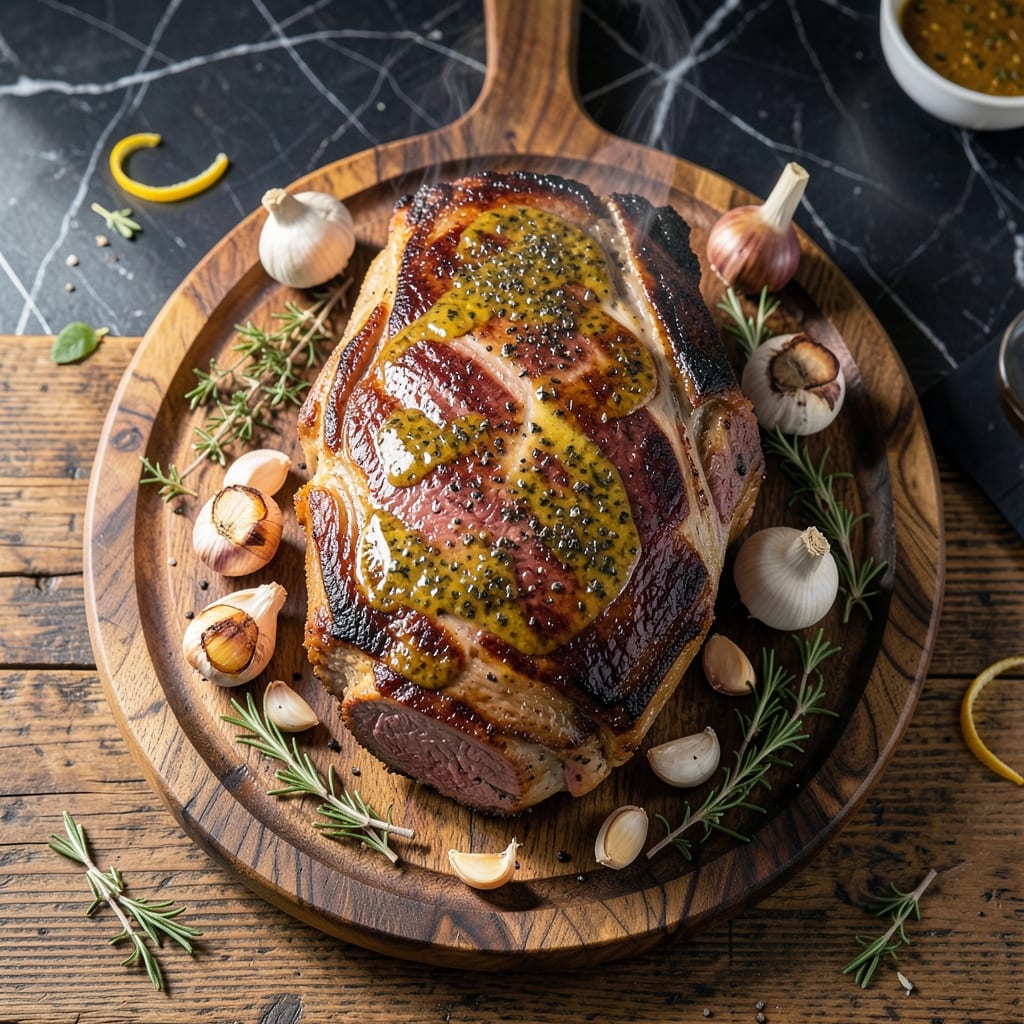
There’s a reason prime rib graces the most celebrated holiday tables—it delivers restaurant-quality elegance with surprisingly simple preparation.
I’ve refined this method over years of holiday dinners, focusing on a herb-crusted exterior and perfectly rosy interior. The key lies in low-and-slow roasting with strategic temperature control.
What emerges is a centerpiece worthy of special occasions: juicy, tender, and encrusted with aromatic herbs. The resting period ensures every slice stays succulent.
Serve with au jus for dipping and watch it disappear. Here’s how to make it unforgettable.
Ingredients for Prime Rib Roast Recipe Nyt
Sixteen ingredients transform into a showstopping centerpiece with a herb-crusted exterior and rosy interior.
| Ingredient | Amount | Notes |
|---|---|---|
| Prime Rib Roast 🥩 | 5 lb | Bone-in, ribeye end preferred |
| Kosher Salt 🧂 | 2 tbsp | Diamond Crystal brand recommended |
| Freshly Ground Black Pepper 🌶️ | 2 tsp | Coarse grind preferred |
| Garlic Cloves 🧄 | 8 cloves | Peeled, smashed into paste |
| Fresh Rosemary 🌿 | 3 tbsp | Finely chopped, stems discarded |
| Fresh Thyme 🍃 | 3 tbsp | Finely chopped, stems discarded |
| Extra-Virgin Olive Oil 🫒 | ¼ cup | High-quality, cold-pressed |
| Dijon Mustard 🟡 | 3 tbsp | Smooth, not whole-grain |
| Dry Red Wine 🍷 | 1 cup | Full-bodied like Cabernet |
| Beef Stock 🥩 | 2 cups | Low-sodium preferred |
| Unsalted Butter 🧈 | 4 tbsp | For herb crust and au jus |
| All-Purpose Flour 🌾 | 2 tbsp | For thickening au jus |
| Yellow Onion 🧅 | 1 whole | Roughly chopped for au jus |
| Carrots 🥕 | 2 whole | Peeled, roughly chopped |
| Celery Stalks 🥬 | 2 whole | Roughly chopped for au jus |
The prime rib is the star—bone-in ribeye end delivers the most flavor and tenderness. Source from a trusted butcher like Whole Foods or a local specialty shop. Look for bright red color with generous marbling (those white fat streaks). Ask for the roast to be dry-aged if available—it concentrates the beefy flavor. For the herbs, fresh rosemary and thyme are non-negotiable; dried won’t deliver the same aromatic punch.
No red wine? Beef broth with 1 tbsp balsamic vinegar works in a pinch. Out of Dijon? Whole-grain mustard at half the quantity adds texture. If using pre-minced garlic, reduce to 2 tbsp—it’s more potent. For the au jus, substitute vegetable stock if avoiding beef, though the flavor depth will be milder. The butter in the crust can be swapped for olive oil, but it won’t brown as richly.
Store the roast uncovered in the fridge for 1-2 days before cooking to dry the surface—this ensures a better crust. Leftover slices keep for 4-5 days wrapped tightly, and au jus freezes beautifully for 3 months. Always bring meat to room temperature before roasting for even cooking.
Why You’ll Love This Recipe
- Unfussy Luxury: I just rub the roast with salt, pepper, garlic, and rosemary—no fancy techniques, just big flavor.
- That Garlic-Rosemary Crust: Honestly, the smell alone is worth it. The herbs and garlic form this crisp, fragrant crust that’s ridiculous with every bite.
- Holiday Hero: It’s my go-to for Christmas dinner, but I’ve made it for Sunday suppers too—always impressive.
- Leftovers for Days: One roast feeds us for two meals, and the sandwiches the next day? Even better than the first serving.
Step-by-Step Instructions for Herb-Crusted Prime Rib Roast
Master the technique for a showstopping centerpiece with rich flavor and perfect doneness.
Step 1: Prepare the Herb Crust and Season the Roast
In a small bowl, combine the 3 tbsp Fresh Rosemary, 3 tbsp Fresh Thyme, 8 cloves Garlic Cloves (smashed into a paste), 2 tbsp Kosher Salt, and 2 tsp Freshly Ground Black Pepper with the 0.25 cup Extra-Virgin Olive Oil and 3 tbsp Dijon Mustard. This aromatic paste will form a flavorful crust.
Pat the 5 lb Prime Rib Roast dry with paper towels, then rub the herb mixture evenly over the entire surface, pressing it into the meat. I ensure every crevice is coated—this guarantees maximum flavor penetration. Let the roast sit at room temperature for 1 hour before cooking to take the chill off.
Step 2: Sear and Begin the Roasting Process
Preheat your oven to 450°F. Place the roast bone-side down in a roasting pan. Roast for 20 minutes to create a deeply browned crust. This high-heat sear develops the Maillard reaction, which gives the roast its signature depth of flavor.
After the initial sear, reduce the oven temperature to 325°F. This two-step temperature method ensures a perfect crust while allowing the interior to cook evenly without over-browning. Do not cover the roast—this prevents the crust from steaming.
Step 3: Roast to Desired Doneness
Continue roasting at 325°F until the internal temperature reaches 120-125°F for medium-rare. For a 5 lb Prime Rib Roast, this typically takes 1.5 to 2 hours, but rely on a meat thermometer rather than time alone. Insert the thermometer into the thickest part of the meat, avoiding the bone.
For even more precise results, I check the temperature in multiple spots. The roast is done when the thermometer reads 115-120°F before resting, as the internal temperature will rise 5-10°F during the resting period. This ensures a perfectly pink, juicy center.
Step 4: Prepare the Au Jus
Transfer the roast to a cutting board to rest and make the au jus. In the same roasting pan, add the 1 whole Yellow Onion, 2 whole Carrots, and 2 whole Celery Stalks, all roughly chopped. Place the pan on the stovetop over medium heat.
Pour in the 1 cup Dry Red Wine and deglaze the pan, scraping up all the browned bits with a wooden spoon. Let the wine reduce by half, about 5 minutes. Add the 2 cups Beef Stock and bring to a simmer.
In a small bowl, mix the 2 tbsp All-Purpose Flour with 2 tbsp of the 4 tbsp Unsalted Butter to form a beurre manié. Whisk this into the simmering au jus and cook for 3-4 minutes until thickened. Strain and keep warm.
Step 5: Rest, Carve, and Serve
Let the roast rest for 20-30 minutes before carving. This allows the juices to redistribute, ensuring each slice is moist and flavorful. Tent loosely with foil to keep it warm. I always rest the roast bone-side down so the juices pool toward the meat rather than the cutting board.
Carve the roast by slicing between the bones for elegant, even portions. Serve immediately with the prepared au jus. The bone-in presentation adds to the visual appeal, while the herb crust provides a fragrant, savory finish that complements the rich, beefy flavor.
Pro Tips For Making Prime Rib Roast Recipe Nyt
- Dry the Roast: Pat the prime rib thoroughly dry with paper towels before seasoning—I learned this the hard way after my first roast steamed instead of seared.
- Salt Generously: Use more kosher salt than you think, especially on the fat cap, and let it sit uncovered in the fridge overnight for a deeper crust.
- Skip Cold Meat: Pull the roast out of the fridge 2 hours before cooking so it starts at room temperature—cold meat cooks unevenly, no matter the oven.
- Rest Like a Pro: Tent it loosely with foil and let it rest 20-30 minutes after roasting; the juices will redistribute instead of spilling onto the cutting board.
Troubleshooting Perfect Results
Uneven Cooking
If one end of your roast is more done than the other, your oven likely has hot spots. I rotate my pan 180° halfway through cooking. Also, bone-in roasts cook faster near the ribs—use a thermometer to check both ends. 🌡️
Dry or Tough Meat
This usually means it was overcooked or not rested properly. Pull your roast at 115-120°F for medium-rare and let it rest 20-30 minutes. Slicing too soon causes juices to escape, leaving the meat dry.
Poor Crust Formation
For a better crust, ensure the roast surface is very dry before seasoning. I pat mine with paper towels for 5 minutes. Also, don’t skip the high-heat sear at 450°F for 20 minutes to start.
Au Jus Too Thin
If your au jus doesn’t thicken, your beurre manié might need more cooking. Simmer for an additional 2-3 minutes. Alternatively, mix 1 tsp cornstarch with 1 tbsp water and whisk in.
Over-Salted Crust
Diamond Crystal salt is less dense than Morton’s. If using Morton’s, reduce to 1 tbsp. For already seasoned meat, soak slices in warm au jus for 5 minutes to balance the saltiness. 💡
Roast Sticks to Pan
Use a heavy roasting pan with a rack. Place the roast bone-side down on roughly chopped onions to elevate it. This prevents sticking and adds flavor to your au jus.
Nutrition Facts
Frequently Asked Questions
What’s the ideal internal temperature for medium-rare?
Remove the roast at 115-120°F—it will rise to 125-130°F while resting. This ensures a perfect rosy center
Do I need to cover the roast while cooking?
No, leave it uncovered. Covering steams the crust, preventing that coveted browned exterior. Only tent with foil during resting
Can I use pre-minced garlic?
Yes, but reduce to 2 tbsp—it’s more concentrated than fresh. For best flavor, fresh smashed garlic paste is ideal
How long should I let it rest before carving?
Rest for 20-30 minutes to let juices redistribute. Slicing too soon makes the meat dry and less flavorful

- Pudding Recipe With Egg Yolks: Silky Smooth Custard in Minutes - November 3, 2026
- Pudding Pops Recipe Cook and Serve: Silky Frozen Treats Without the Machine - November 3, 2026
- Protein Ice Cream Recipe Blender Xanthan Gum: Ultra Creamy Texture Without the Guilt - November 3, 2026